Summary: To choose leadership training in 2027, start with one behavior you want managers to change. Ask each provider to show how managers would practice it in a live session and get feedback. Before you commit, compare the full cost and decide how you’ll check whether managers use the skill at work.
After a reorganization, managers may need to reset team priorities. On a team using AI, they may need to decide who checks AI-assisted work before it goes out. Name the situation managers need to handle, then ask providers how managers will rehearse it, get feedback, and try it on the job.
If managers across teams need a shared approach, LifeLabs Learning’s Manager Core Program gives them live practice in coaching, feedback, delegation, and 1:1s. In the Skills Lab, a facilitator helps managers apply what they learned to a real work challenge.
Key takeaways
- In LifeLabs Learning’s 2026 Mid-Year Workplace Trends Report, 56% of respondents rated their organization’s manager coaching and feedback capability at 5 out of 10 or lower. If you’re deciding what to train first in 2027, look at where managers are putting off feedback or where employees leave 1:1s without a next step.
- Ask to see a live exercise. Find out who gives managers feedback, whether they get another try, and where they’ll use the skill that week.
- If AI is changing how teams work, ask to see managers practice deciding what to hand off to AI, what people still own, and who checks the result.
- Give each provider the same workplace scenario. Ask them to show how they’d build it into practice.
- Price the full program and pick one behavior to check before and after the first cohort.
What should HR leaders prioritize in 2027 leadership training?
Protect time for coaching and feedback, especially where managers are helping teams work through change. Start with one conversation they need to handle more often or more skillfully.
In LifeLabs Learning’s 2026 Mid-Year Workplace Trends Report, 56% of respondents rated their organization’s manager coaching and feedback capability 5 out of 10 or lower.
Consider the questions managers bring to HR and what employees say in engagement surveys. If several teams say they hear about problems for the first time in performance reviews, find out where managers get stuck. When you train managers for performance conversations, have managers rehearse the part they find hardest. If a manager keeps putting off the conversation, have them practice how to open it. If they get sidetracked when an employee pushes back, have them practice how to respond and return to the concern.
What can you customize in leadership training?
You can customize the scenarios managers practice, the tools they use, and how sessions fit into their week. For a growing company, that might mean rehearsing the same coaching approach across newly formed teams. In a hospital, it might mean practicing how to give useful feedback in the few minutes between shifts.
Bring a situation your managers know well. If you’ve just rolled out a new performance review framework, ask the provider how they’d use it to help a manager rehearse a conversation about a missed deadline.
Scheduling can shape the design, too. If your managers can only meet for an hour at a time, find out how the provider would space the sessions and give them time to practice between workshops.
LifeLabs Learning’s custom leadership training programs can build practice around the manager expectations and tools your teams already use.
What skills should leadership training help managers practice?
Leadership training for people managers should cover coaching, feedback, delegation, and effective 1:1s. The symptoms can help you decide where to start. If every decision comes back to the manager, start with delegation. If employees leave 1:1s with a list of updates and nowhere to turn for help, start with coaching.
Coaching when someone gets stuck
LifeLabs Learning teaches managers to use Q-Step when an employee asks for help. Before offering advice, pause and ask an open-ended question like “What have you tried so far?” When you’re comparing coaching workshops, ask to see how the facilitator helps managers practice that pause.
Feedback when the conversation gets uncomfortable
Look for a method managers can use to prepare for their next feedback conversation. LifeLabs Learning’s Feedback Prep Grid helps managers prepare a specific example and decide what they want the other person to take away.
Delegation and effective 1:1s
In a delegation workshop, look for practice naming the outcome, the decisions the employee owns, and when to check in. LifeLabs Learning’s GEMS Method gives managers a way to do that.
In training for effective 1:1s, listen for how managers make room to coach when project updates usually fill the agenda. LifeLabs Learning’s CAMPS framework gives managers five needs to check in on during a 1:1: certainty, autonomy, meaning, progress, and social inclusion. To check for certainty, a manager might ask, “What feels unclear about your priorities this week?”
Compare leadership training formats
Match the format to the skill. If managers need to get comfortable giving feedback, give them time to rehearse with another person. If they need a reminder of how to open the conversation, give them a guide they can pull up five minutes before the meeting.
Live, on-demand, and blended training
| Training format | Good fit when | What to ask the provider |
| Live, facilitator-led | Managers need to rehearse conversations or get feedback in the moment. | How much time will managers spend practicing? Who gives feedback, and do managers get another try? |
| On-demand | Managers need to learn on their own schedule or refresh a skill before using it. | What can a manager pull up five minutes before a difficult conversation? |
| Blended | Managers need live practice and tools they can revisit between sessions. | Which skills will managers practice live, and what will they use back at work? |
Ask to observe a session. Watch what the facilitator does when a participant gets stuck, and whether the participant gets another try. LifeLabs Learning’s live events let you see its facilitators in action.
Virtual, in-person, or hybrid delivery
Once you know how managers need to practice, decide where they’ll do it. A live workshop can run virtually or in person. A hybrid program can use both. For distributed teams, check whether live virtual sessions work across time zones. For teams that already gather in person, consider using that time for hands-on practice.
LifeLabs Learning’s Manager Core program is available virtually, in person, or in a hybrid format, with 60-, 90-, or 120-minute workshop options.
Private cohorts and open enrollment
Private cohorts work well when managers across teams need a shared approach to coaching or feedback. Open enrollment can be a good fit when you’re training a few managers or need more scheduling options.
| How Self-Help trained 200+ managers with a one-person L&D team If you have a small L&D team or no in-house facilitators, ask what the provider will handle and what your team will need to cover. For a rollout across locations, find out who will lead each session and how they’ll give managers the same opportunities to practice. The Center for Community Self-Help had a one-person L&D team and branches across the country. It partnered with LifeLabs Learning to run the Manager Core Program in cohorts. More than 200 managers completed the Program, representing over 80% of Self-Help’s people leaders. Manager Core also became part of onboarding for new managers. “For Self-Help, every dollar invested with LifeLabs paid off many times over, not just in stronger leaders, but in a stronger culture.” – Katrin Baker, Director of L&D |
When to include AI readiness in leadership training
Include AI readiness in leadership training when managers are already making decisions about how teams use AI. In LifeLabs Learning’s 2026 Mid-Year Workplace Trends Report, 58% of respondents said AI adoption felt improvised. Find out which decisions managers are making on their own today and build practice around one of them.
Suppose an employee brings an AI-drafted customer update to their manager. Who checks the product claims before it goes out? Use an exercise like that to practice deciding where AI can help, what needs a human review, and who’s responsible for sending the final version.
LifeLabs Learning’s AI Transformation Program gives managers live practice deciding where AI belongs in the work, setting expectations for AI-assisted work, and helping teams adopt new practices. In the Skills Lab that follows, managers bring a current work challenge and get feedback as they apply what they learned.
If you’re deciding which skills belong in your manager training plan, see LifeLabs Learning’s guide to the leadership skills managers need for AI transformation in 2027.
How to compare leadership training providers
Give each leadership training provider the same workplace scenario and ask for a sample exercise. Compare how closely the exercise matches your managers’ work, who gives feedback during practice, and what managers will try between sessions. If you plan to train several cohorts, agree on what you’ll measure in a pilot before you expand.
Step 1. Name the behavior you want to change
Describe the problem in terms a provider can design around. “We need better delegation” leaves a lot open. “Projects keep coming back for revisions because people leave handoffs with different ideas of what’s due” gives a provider a situation to build into practice.
Give providers the audience, timing, and budget range up front. Include one example of the behavior you’d like to see after training. For delegation, that might mean managers and employees agree on who signs off and what a first draft should cover.
Step 2. Check how the training fits your managers
Share a tool your managers already use. Have the provider show how it would come up in practice.
Look at the agenda with your managers’ calendars and experience in mind. What would a first-time manager need to see modeled? Could a second cohort get the same practice time if it meets in another time zone?
Step 3. Ask how managers will practice and follow through
A sample agenda can show how much time managers spend practicing the skill and who gives them feedback. Ask what they’ll take back to work, too. A conversation guide is more likely to get used if managers leave with a specific meeting in mind.
The LifeLabs Learning Platform offers resources tied to learners’ training and on-demand courses for select topics. LabCoachᴬᴵ is an optional paid add-on for additional practice.
Step 4. Decide how you’ll measure progress
A sample report will tell you what the provider can measure. Attendance tells you who showed up. To see what carries over, agree on one behavior you can check after managers are back at work.
If better 1:1s are the goal, check how often those meetings happen before training and again 60 days later. Ask employees what happens in the meetings, too. Try “When you bring a problem to your 1:1, do you leave knowing what to try next?”
Step 5. Test the fit before you commit
Ask the provider to walk through one of your managers’ real scenarios. If you’re planning multiple cohorts, consider starting with a pilot and agreeing up front on what would justify expanding it.
What to look for in a facilitator
Meet the person who’ll facilitate your sessions and bring a moment your managers find hard. Say a manager raises a performance concern and the employee goes quiet. How would the facilitator help the manager respond, then give them another chance to try?
Listen for the words the facilitator would model. Then see how they’d help the manager say it in a way that feels natural. LifeLabs Learning facilitators teach science-backed Tipping Point Skills™, small behaviors managers can use right away. For example, in the Point-It-Out Method, a facilitator might help a manager name a behavior worth repeating: “You flagged the deadline as soon as it was at risk. That gave us time to adjust the plan.”
If you’re training multiple cohorts, ask how the provider prepares facilitators to teach the same methods and give consistent feedback across groups.
How to budget for leadership training
Build the budget around the first group you need to train. You’ll want to know the program cost, how much time your team will spend on it, and what you’ll review before funding another cohort.
Decide which managers to train first
Start with the people closest to the problem. If new managers are still doing work they could hand off, give them practice coaching and delegating. If experienced managers are setting different standards for AI-assisted work, bring them together to practice setting clear expectations for their teams.
Estimate how many cohorts you’ll need, when each can attend, and whether their managers can protect time to practice between sessions.
Compare the full cost
To compare the full cost of leadership training, include:
- Provider fees. Facilitation, follow-up practice, and reporting.
- Internal coordination. Time for scheduling and follow-up.
- Manager time. Hours spent in sessions and practicing between them.
- Delivery costs. Travel or backfill, if needed.
Build the budget case for Finance
Give Finance the business problem, a baseline, who would join the first cohort, and the full cost. Name the behavior you’ll track and when you’ll review the results. Use this guide to get executive buy-in for leadership development to put the proposal together.
With a limited training budget, SiteCompli paired LifeLabs Learning’s manager training with practice groups it ran in-house. The company measured progress through its existing employee engagement survey, which it ran every six months. It reported a rise of more than 25% in survey scores tied to people management skills.
Red flags to avoid when choosing leadership training
Programs that promise instant results
If a provider promises a quick jump in performance, ask what changed in a real team and how long it took to see it. Find out what managers did between sessions and what the organization did to support them.
Providers that rely heavily on content libraries
A course library can help someone refresh a skill before a tough conversation. If the proposal is mostly a catalog, ask where managers will get to say the words out loud, hear how they land, and try again.
No plan to measure behavior change
A full room and strong workshop ratings tell you something about the session. Find out what the provider can tell you about skill use afterward and what you’ll need to check with employees or managers yourself. At LifeLabs Learning, 99% of learners report they’re still using the skills they learned three months after training.
Decide what to train next
Use feedback from the first cohort and their teams to decide what to train next. If 1:1s are happening more often but employees still leave unsure what’s expected of them, keep working on those conversations. If the next challenge is keeping teams aligned through a reorganization, look for training in leading change.
If you’re adding a second cohort, check whether those managers face the same problem as the first group. A cohort of new managers may still need practice with the basics while the first group moves on to leading change.
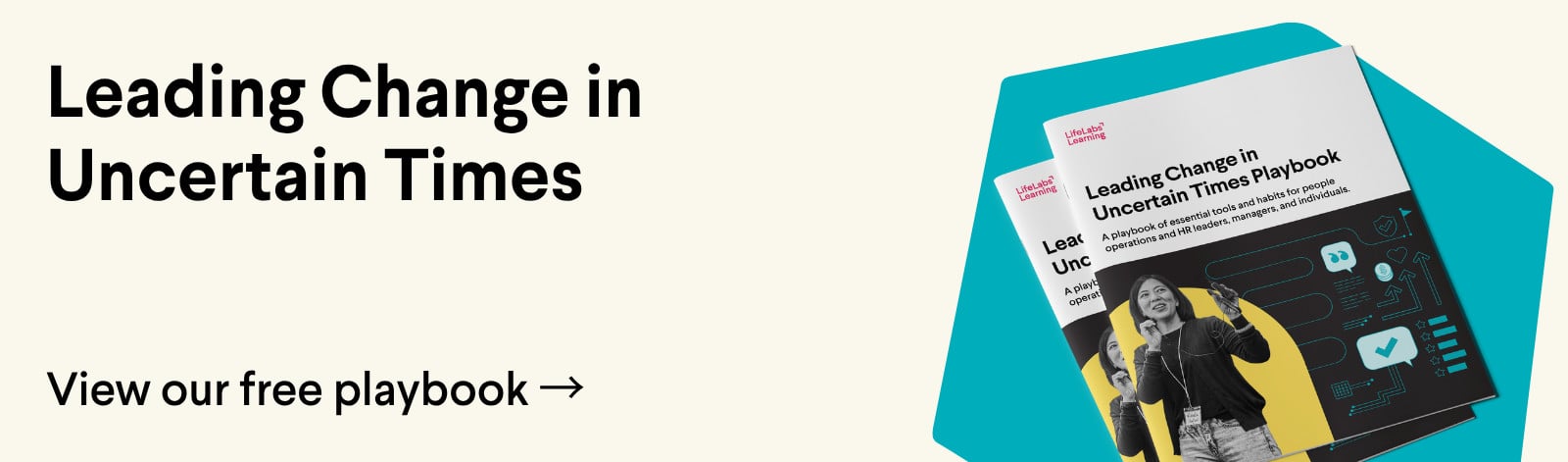
If leading change is next on your plan, the Leading Change in Uncertain Times Playbook includes a checklist for HR and a 1:1 agenda managers can use with their teams.
What should HR include in a leadership training brief?
Give every provider the same brief so you can compare their proposals. Here’s an example you can adapt if you want managers to do more coaching in their 1:1s.
- Who and when. 24 people managers this quarter. Sessions need to fit into one-hour blocks.
- What’s happening now. Employees say their 1:1s mostly cover project updates.
- What should change. Managers make time to coach when an employee is stuck.
- What to show in the proposal. Show how managers will practice coaching in a 1:1, what they’ll try between sessions, and how we can check with employees 60 days later.
- Budget. Our budget range is [insert range]. Please include facilitation, follow-up practice, and reporting in your quote.
Planning training across teams? Talk with a LifeLabs Learning consultant about where to start. Bring your training brief so you can work through who should join the first cohort, what managers should practice, and what to measure before you expand.
FAQs about choosing leadership training
When should we start with a leadership training pilot?
Start with a pilot when you plan to train several cohorts and want to see whether the program fits your managers’ work and schedules. Choose one group facing the problem, agree on what employees should see managers do differently, and check for that change before funding the next cohort.
How much should we budget for leadership training?
Build your budget around the number of managers, the skills they need, and how the training will be delivered. Ask providers to include facilitation, follow-up practice, and reporting in their quotes. Add the time your team will spend coordinating the program.
What’s the difference between customizable training and off-the-shelf programs?
Customizable training can adapt practice scenarios, internal terminology, and scheduling to your team. Ask a provider for a sample exercise that uses a real situation or a framework your managers already use.
How do you measure whether leadership training works?
Pick one behavior and measure it before training and again 60 days later. If you want managers to coach more in 1:1s, ask employees the same question both times: “When you bring a problem to your 1:1, do you leave knowing what to try next?”
If you’re training managers to delegate, estimate the value of the time teams save by doing less rework after handoffs. Use the savings you can reasonably attribute to training. To calculate ROI as a percentage, subtract the full cost of training from that dollar value, divide by the training cost, and multiply by 100.
Can leadership training programs be delivered virtually?
Yes. Live virtual leadership training can give distributed managers time to practice in pairs or small groups and get real-time feedback. Ask providers to show how a virtual session works and how they schedule across time zones.