
Summary: Learn how to give effective manager feedback with practical examples, proven techniques, and six LifeLabs Learning Methods and Behaviors. Explore best practices for constructive feedback, performance reviews, and one-on-ones that help managers build trust, improve performance, and make feedback an everyday habit.
Great feedback helps people see exactly what they’re doing well and what they could do differently. Yet even experienced managers can fall into familiar habits: giving vague praise, delivering feedback too late, or postponing conversations until performance review season.
A few small changes can make feedback easier to give and receive, and much more useful. This guide covers practical feedback methods, workplace feedback examples, and repeatable habits you can apply in performance reviews and weekly one-on-ones. You’ll learn how to help managers make feedback more specific, invite a two-way conversation, and build regular opportunities to practice.
Key takeaways: manager feedback best practices
- Effective manager feedback is behavior-specific, timely, and tied to observable actions rather than personality traits.
- The LifeLabs Learning Point-It-Out Method helps managers make vague feedback specific by naming a behavior to repeat or change.
- Regular one-on-ones give managers time for ongoing feedback and coaching.
- LifeLabs Learning builds feedback skills through sequenced workshops, real-work application, and Skills Lab reinforcement.
- Practice and reinforcement help managers keep using feedback skills at work.
Why manager feedback can break down
Feedback can be hard to use when it’s vague, delayed, or disconnected from the work. To make it effective, managers need a clear way to structure feedback conversations, practice handling uncomfortable moments, and regular opportunities to give and ask for feedback. When feedback is saved for the annual performance review, arrives too late to be actionable, and feels more like a verdict than a conversation, employees leave unsure what to do differently, and managers leave feeling the process was unproductive.
In polling cited in LifeLabs Learning’s 2026 Mid-Year Workplace Trends Report, 56% of respondents rated manager coaching and feedback capability at 5 out of 10 or lower. Giving managers clear methods and regular opportunities to practice offers a practical starting point for improvement.
What effective manager feedback looks like
Feedback that changes behavior shares a few consistent characteristics. It’s specific enough that the recipient knows exactly what action you’re referencing. It’s timely enough that the context is still fresh. And it connects the behavior to a clear outcome so the person understands why it matters.
Compare these two approaches. The first: “You did a great job in that meeting.” The second: “In today’s client review, you summarized the three open issues before asking for input. That kept the conversation focused and helped us reach a decision in 20 minutes instead of the usual hour.”
The second version names the situation, describes the specific behavior, and explains the result.
Naming the specific behavior is the idea behind the Point-It-Out Method taught in LifeLabs Learning’s Leading AI Adoption Workshop. Explaining the feedback’s impact helps the person understand why it matters.
Here’s how to practice it:
- Notice vague feedback. Listen for general reactions like “Great job!” or “That didn’t go well.” These comments communicate approval or disapproval without explaining what someone did.
- Point to the behavior. Identify the specific action you’d like someone to repeat or change.
- Repair vague feedback. Catch yourself giving a general reaction? Pause and get more specific.
- Reinforce the habit. When someone gives you specific, useful feedback, acknowledge what made it helpful.
How to give constructive feedback without damaging trust
Constructive feedback can feel high stakes, especially when you care about the relationship. The key is to make the conversation specific, useful, and two-way. Start with a behavior you’ve noticed, get curious about the other person’s perspective, and work together to identify what could change next time.
LifeLabs Learning’s Feedback Prep Grid can help managers prepare for tough conversations. Ours encourages asking questions, focusing on observable behaviors, and understanding why the feedback matters.
Three practices that protect trust during difficult feedback
Ask before you tell. Before delivering feedback, ask the person how they think the interaction went. Often, they already see the issue. Starting with their perspective builds a shared understanding rather than a one-way evaluation.
Stay with one behavior at a time. Stacking multiple pieces of feedback in a single conversation makes it harder for the recipient to act on any of them. Choose the one behavior that will make the biggest difference and focus there.
Close with a clear next step. Feedback without a forward path feels like criticism for its own sake. End by agreeing on one concrete action the person will take and when you’ll check back in.
How to build feedback into weekly one-on-ones
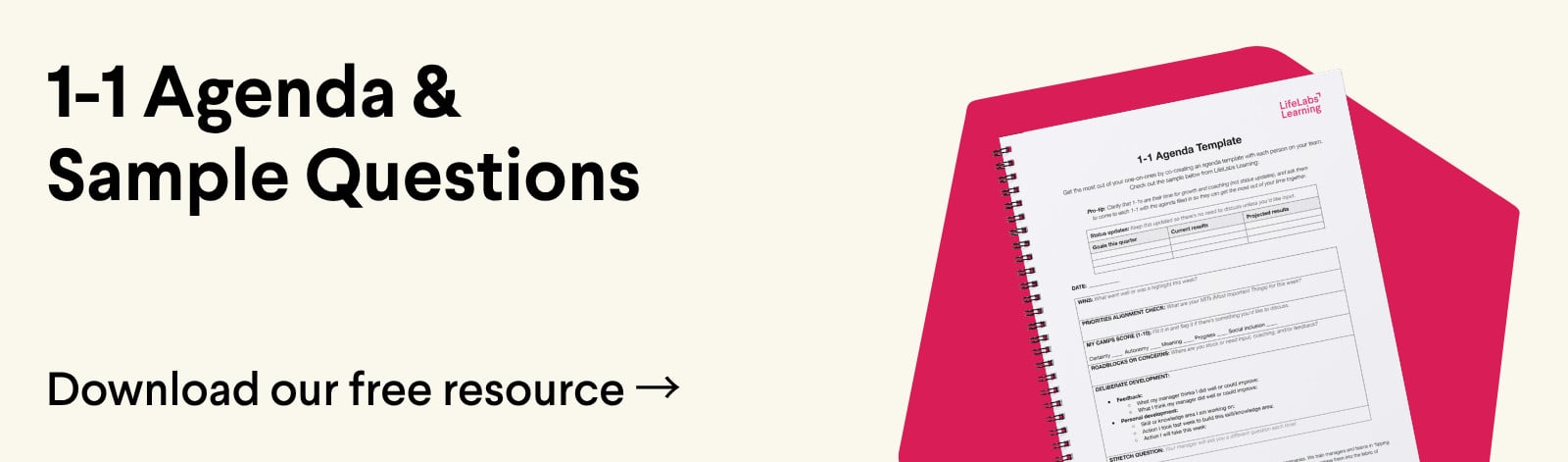
While performance reviews only happen once or twice a year, regular one-on-ones give managers ongoing opportunities for feedback, development conversations, and coaching. Feedback can also happen between meetings when there’s something useful to share.
Yet many managers treat one-on-ones as status updates. They run through project timelines, flag blockers, and end the meeting without any development conversation. The MIT Human Resources office describes ongoing coaching and feedback as “frequent, two-way conversations about performance and development” that “create shared responsibility and accelerate employee growth and impact.” That definition only works if the one-on-one is designed for it.
A simple one-on-one feedback structure
Open with a check-in question. Something like “What’s one thing that went well this week?” invites the employee to lead with their own reflection, which sets a collaborative tone.
Share one piece of specific feedback. Point to the behavior you’d like the person to repeat or adjust, and explain why it matters.
Ask for feedback in return. Modeling vulnerability by asking “What’s one thing I could do differently to support you?” signals that feedback flows both ways. Ask a specific question, listen without defending your approach, and thank the person for the input.
Close with a commitment. Both parties should leave with one clear action. Write it down. Revisit it next week. This simple loop turns feedback from a one-time event into a continuous practice.
How to give feedback during performance reviews
Annual and semiannual performance reviews carry more weight than weekly one-on-ones because they’re formally documented and often tied to compensation, promotions, and development plans. That weight is exactly why feedback in performance reviews needs to be specific, evidence-based, and free of surprises.
Ideally, performance reviews should bring together feedback you’ve already discussed throughout the year. Regular check-ins help employees understand what’s working, where they can grow, and how their progress connects to expectations.
Structuring performance review feedback
Anchor to goals and expectations. Review the goals set at the beginning of the cycle. For each one, describe what the employee accomplished, where they met expectations, and where there are gaps. Use specific examples from throughout the review period.
Balance recognition with development areas. Recognize genuine strengths and identify development needs supported by examples. Focus development feedback on one or two behaviors the employee can work on in the next cycle.
Use the same frameworks you use in one-on-ones. Ground feedback in observable actions and concrete examples.
SHRM’s research indicates 43% of HR professionals say their organization doesn’t provide sufficient training or resources to people managers for performance reviews. A shared feedback method and examples of behavior-specific language give managers a starting point for useful reviews.
6 LifeLabs Behaviors & Methods for better manager feedback
To give great feedback, managers need to know how to start the conversation, make their message actionable, and invite the other person’s perspective. At LifeLabs Learning, we focus on small, practical behaviors that help people give and receive feedback more effectively. Here are six you can start using right away.
1. Playing Cards Method: make feedback more actionable
The Playing Cards Method™ helps managers distinguish between vague feedback and feedback that gives people something specific to act on.
It uses four playing card suits:
- Club: Blurry critique, such as “You weren’t professional in that meeting.”
- Heart: Blurry praise, such as “Great presentation!”
- Spade: Specific critique that identifies a behavior to change.
- Diamond: Specific praise that identifies a behavior to repeat.
The goal is to give more Spades and Diamonds so people know exactly what they’re doing well and what they could do differently.
2. Point-It-Out Method: name the behavior
The Point-It-Out Method helps turn general reactions into specific feedback by naming an observable behavior someone should repeat or adjust.
For example, if you receive vague feedback, ask, “Which behavior would you like me to repeat or change?” If you catch yourself giving vague feedback, you can repair it right away by pointing to the behavior you actually noticed.
3. Deblur: make vague language specific
Words like “professional,” “proactive,” and “collaborative” can mean different things to different people. The Deblur Behavior helps managers replace unclear language with concrete examples and observable actions.
For example, rather than saying, “You need to be more proactive,” try, “When you notice a project deadline is at risk, please flag it in our project channel and suggest a next step.”
Managers can also Deblur feedback they receive by asking, “What would that look like in practice?” or “Can you share an example?”
4. Q-Step: ask before offering advice
The Q-Step Behavior encourages managers to pause before giving advice and ask an open-ended question that helps the other person think through a challenge.
For example, after discussing a difficult client meeting, ask, ‘What could you try next time?’ before offering your own solution.
Questions can reveal information managers might otherwise miss and help employees take a more active role in their development.
5. Micro-Yes: open the door to feedback
Feedback can catch people off guard, especially when it’s constructive. LifeLabs’s Micro-Yes Behavior encourages you to ask a brief question that signals feedback is coming and gives the other person an opportunity to engage.
For example: “Would you be open to some feedback about yesterday’s meeting?”
This small opening helps reduce surprise and creates a more collaborative starting point for the conversation.
6. Pull for Feedback: make feedback a two-way habit
According to Gallup research, less than half of U.S. employees report having the opportunity to formally provide feedback to their manager. Fewer than one in four have ever formally rated their manager’s performance.
Great managers give feedback and ask for it. The Pull for Feedback Behavior invites regular, specific input about your own behaviors and impact.
Instead of asking, “Do you have any feedback for me?” try something more focused: “What’s one thing I could do differently to make our one-on-ones more useful?”
Thank the person, ask a clarifying question if needed, and choose what you’ll try. Follow up to share what changed.
Putting these Behaviors & Methods together
Managers don’t need to use all six in every conversation. A Micro-Yes can help open the conversation. Playing Cards or Point-It-Out can make feedback specific, and Deblur clarifies vague language. Q-Step is useful before offering advice. Pulling for Feedback keeps managers learning about their own impact.
With practice, these small behaviors can help make feedback a useful, ongoing conversation rather than something saved for performance review season.
How to train managers to give better feedback
Strengthening manager coaching and feedback skills was the top organizational priority for 52% of respondents in polling featured in LifeLabs Learning’s 2026 Mid-Year Workplace Trends Report.
A feedback method gives managers a starting point. Using it under pressure takes practice. That’s why LifeLabs Learning’s feedback training focuses on live practice. In a facilitator-led workshop, managers practice giving and receiving feedback using real scenarios from their own work. They get immediate coaching from peers and facilitators, so managers can try new approaches and get feedback before using them at work.
According to ATD research, feedback is a major focus of manager development training across organizations. The top goals of these programs are to improve performance by both the manager and the manager’s direct reports. ATD also found that high-performing organizations were especially likely to use pre- and post-training activities and bite-sized learning in manager training.
What effective feedback training includes
Shared methods. Teach managers practical approaches like the Point-It-Out Method so they can make feedback more specific and actionable.
Live practice with coaching. Reading about feedback is not the same as doing it. Live practice in a safe environment, where managers can try the conversation and get real-time coaching, is what builds confidence. The LifeLabs Learning Manager Core Program integrates feedback practice into a broader skill-building sequence that includes coaching, delegation, and effective one-on-ones.
Reinforcement after the workshop. Practice and reinforcement help managers keep using feedback skills. Skills Lab is the live, facilitator-led capstone included in every LifeLabs Program. Learners bring real workplace challenges and practice skills from across the Program. LabCoachAI is additional on-demand support for recalling, practicing, and applying skills learned in our workshops.
Common feedback mistakes managers make
Even well-intentioned managers fall into patterns that reduce feedback effectiveness. Recognizing these patterns is the first step toward changing them.
Waiting too long to give feedback
Share feedback while the situation is still fresh, choosing a time and setting where you can both focus. Name the specific behavior and its impact so the person knows what to repeat or change.
Making it about personality instead of behavior
Telling someone “you’re disorganized” labels them. Telling someone, “The status report you submitted Friday was missing the budget section, and the team could not make a staffing decision as a result,” describes a behavior and its impact. The second version gives the person something specific to change.
Giving feedback only when something goes wrong
Regular positive feedback that names specific behaviors helps people recognize what they’re doing well and makes feedback a familiar part of work.
Overloading a single conversation
Stacking multiple pieces of feedback into one meeting can overwhelm the recipient. Start with the behavior that matters most. If several issues need attention, agree on priorities and next steps so the person knows where to focus.
How to create a feedback culture across your organization
One great feedback conversation can help someone improve. But imagine what happens when an entire team gets comfortable giving and asking for feedback. For HR and People leaders, the opportunity is to make feedback a natural part of how work gets done. Think regular one-on-ones, project retrospectives, and leaders who openly ask what they could do better.
Normalize asking for feedback, not just giving it
When leaders publicly ask their teams for feedback and visibly act on it, they signal that feedback is a two-way practice. Thank people for their input and show what you do with it, so asking for feedback becomes part of how the team works.
Build feedback into existing rhythms
Rather than creating new processes, embed feedback into existing meetings and rituals. Add a feedback question to your one-on-one template. Include a “recognition moment” at the start of team meetings. Use retrospectives to practice peer feedback.
Invest in shared language
A shared method like Point-It-Out gives teams a common way to recognize vague feedback and ask for specifics.
LifeLabs Learning’s leadership development programs build shared skills through sequenced workshops, application between sessions, and Skills Lab reinforcement. Managers practice language they can use in their own conversations and with one another.
How to measure whether your feedback practices are working
Look for changes in feedback quality and use, then consider broader team outcomes. The measures below can help you assess progress, but no single measure shows that feedback training caused a change.
Employee engagement scores
Monitor survey questions about recognition, useful feedback, growth, and manager support. Review trends alongside evidence of how managers give and ask for feedback. Engagement scores can add context, but they don’t isolate the effect of feedback training.
Performance review quality
Look for feedback that names specific behaviors and gives people useful next steps. If you’re seeing more of it in performance reviews, that’s one encouraging sign managers are putting their skills into practice.
One-on-one frequency and satisfaction
Ask whether one-on-ones happen regularly and whether employees find the feedback specific and useful. Frequency and satisfaction can provide context; pair them with examples of feedback quality.
Retention and regretted attrition
Track voluntary turnover, including regretted attrition, alongside feedback-quality measures. If turnover changes, consider other factors such as pay, workload, leadership changes, and the job market before drawing conclusions about training.
Building a feedback practice that lasts
Giving and receiving feedback are skills people can strengthen through practice. The practices in this guide give you a starting point: Point-It-Out for making feedback actionable, consistent habits for one-on-ones and performance reviews, and organizational routines that keep feedback flowing.
To build a lasting practice, give managers shared methods, time to try them, and support to keep using them in everyday work.
Want to help managers turn feedback into an everyday habit?
LifeLabs Learning’s Manager Core Program helps organizations build consistent leadership behaviors through science-backed Tipping Point Skills™, sequenced Workshops, and Skills Lab reinforcement. With expert facilitators, managers practice feedback and other everyday leadership conversations.
FAQs about manager feedback best practices
How can managers make feedback more actionable?
LifeLabs Learning’s Point-It-Out Method helps managers turn vague praise or criticism into specific feedback. The goal is to name an observable behavior someone can repeat or change. This gives employees a practical next step rather than leaving them to interpret a general reaction.
How often should managers give feedback to their team?
Give feedback regularly, while the situation is still fresh. Weekly one-on-ones can provide a reliable opportunity, and useful feedback can happen between meetings too. The Manager Core Program by LifeLabs Learning helps managers build feedback and effective one-on-one skills.
How can I give constructive feedback without damaging the relationship?
Describe a specific behavior, invite the person’s perspective, and agree on a useful next step. LifeLabs Learning’s Playing Cards Method™ helps managers recognize vague praise or critique and make the feedback more specific.
What should a manager include in a performance review?
A strong performance review anchors feedback to the goals set at the beginning of the review cycle. For each goal, describe what the employee accomplished, where they met expectations, and where there are development opportunities. Use specific behavioral examples to make recognition and development opportunities easier to understand and act on.
How do you build a feedback culture across an organization?
Start by training managers in a shared feedback framework so everyone uses the same language. Then embed feedback into existing rhythms like one-on-ones, team meetings, and retrospectives. Leaders should model asking for feedback publicly. LifeLabs Learning’s cohort-based programs build a shared vocabulary across teams, making feedback a normal practice rather than a formal event.
What helps feedback training lead to lasting behavior change?
Managers need opportunities to practice, apply feedback skills at work, and revisit what they’ve learned. LifeLabs Learning Programs combine sequenced Workshops, application between sessions, and Skills Lab, a live, facilitator-led capstone. LabCoach AI offers additional on-demand support for practice and application.