Summary: Explore seven leadership skills that support AI transformation in 2027: delegation, strategic thinking, coaching, productivity and prioritization, feedback, leading change, and building trust. Get practical examples HR and L&D leaders can share with managers to strengthen judgment, clarify accountability, and help teams adapt as work changes.
A team member sends over a report they finished in half the usual time with AI. It looks good. Then the manager starts checking: Where did that figure come from? Does the recommendation fit what we know about this customer? And if the report took less time, what should happen to the rest of the afternoon?
These are the conversations managers need to be ready for as you plan leadership development for 2027. AI is changing the work in front of them, and familiar skills like coaching, delegation, and feedback have new applications.
In LifeLabs Learning’s 2026 Mid-Year Workplace Trends Report, 58% of respondents said AI adoption felt improvised across their organization. Just 14% described it as thoughtful and coordinated. Helping managers establish shared expectations for AI-enabled work is a practical place for HR and L&D to start.
Key takeaways
- Make ownership explicit: AI can assist with a task; a person still owns the result and any required review.
- Connect AI experiments to a specific problem and a clear standard for success.
- Give managers ways to coach judgment and provide feedback on observable actions.
- Account for prompting, checking, and corrections before treating faster production as additional capacity.
- Measure changes in team practices and work quality alongside AI usage.
Which leadership skills help managers lead AI transformation?
1. Delegation: clarify ownership across people and AI
Delegation in AI-enabled work starts with deciding what to hand off to a person and where AI can help. Managers need to consider the outcome, the employee’s opportunity to learn, and the judgment needed to check the work.
LifeLabs Learning’s workplace research found that 72% of respondents identified monitoring, follow-through, and check-ins as the hardest stage of delegation. Our GEMS Method (Goal, Empower, Monitor, Strengthen) helps managers define success, provide resources and authority, agree on check-ins, and reflect on what they learned.
For example, a manager assigning a customer briefing could say: “You own the final briefing. Use our approved AI tool to organize the notes, check each customer claim against the source material, and bring me any recommendation that changes the account strategy before sharing it.”
That gives the employee room to work while making ownership and review expectations clear. Before they begin, ask them to talk through their plan and agree on when to reconnect. Afterward, reflect together: What did AI help with? What needed more checking? What would you do differently next time?
2. Strategic thinking: connect AI use to a business priority
Strategic thinking helps managers connect AI use to a business priority. Start with the problem the team needs to solve, such as slow customer responses, recurring errors, or delayed handoffs.
Consider a support team that wants to respond to customers sooner. The manager looks at current response times and where requests get stuck. If replies spend most of their time waiting for approval, generating drafts faster could just give the approver a bigger pile to work through.
LifeLabs Learning teaches the Link-up Check to connect everyday tasks with broader organizational goals. Before testing an AI workflow, ask: “What does this link up to?” For the support team, the goal might be resolving customer issues sooner. That gives the manager a way to judge whether faster drafting actually improves the customer experience.
3. Coaching: help employees think through AI recommendations
Coaching helps employees think through a decision and explain how they reached it. Picture someone bringing an AI-generated recommendation to a one-on-one and asking, “Should we do this?” It’s a useful moment for the manager to get curious about the thinking behind it.
Our 2026 Mid-Year Workplace Trends Report found that 56% of respondents rated manager coaching and feedback capability at 5 out of 10 or lower. As employees bring AI-generated recommendations into everyday decisions, managers need practical ways to coach the thinking behind them.
LifeLabs Learning teaches Q-Step: pause before offering advice and ask an open-ended question that helps the other person think. A manager might ask, “What options have you considered?” then follow with, “What evidence supports your recommendation?” Listen to the answer before choosing the next question.
If the conversation reveals a gap, agree on what the employee will investigate before reconnecting. When they lack the expertise to evaluate a recommendation, involve someone qualified to review it.
4. Productivity and prioritization: direct the capacity AI creates
Productivity and prioritization help managers decide where the time, attention, and energy AI frees up should go. A faster first draft is a useful start. The team still needs time to set up the task, check the work, make corrections, and handle whatever comes next.
LifeLabs Learning’s Clear Then Steer Method starts with two questions: “What are we freeing capacity from?” and “What should that capacity accomplish instead?” Align with the person doing the work and include the effort AI adds when estimating what’s available.
Say a recurring report takes two fewer hours to draft, but adds an hour of checking. That leaves an estimated hour to work with. The manager and employee might agree to use it for customer follow-up or to ease an overloaded week. After the next reporting cycle, check what actually happened and adjust the plan together.
5. Feedback: name the behavior to repeat or change
Feedback helps employees understand what to keep doing and what to change in AI-assisted work. “Be more careful with AI” may sound clear to the person saying it. The employee still has to work out what “careful” looks like.
The LifeLabs Learning Point-It-Out Method makes feedback specific by naming a behavior to repeat or reduce. For example: “You checked each figure against the original spreadsheet and flagged the two you couldn’t verify. Please keep that source check in the reporting process.” For corrective feedback: “The draft included a customer claim without a source. Before sharing the next version, verify the claim or remove it.”
After sharing feedback, ask what support the employee needs and agree on what they’ll do differently or repeat in the next piece of work.
6. Leading change: turn direction into workable team practices
Leading change means helping people understand what’s changing, what it means for their work, and what to try next. An announcement that an AI tool is available can leave a team with plenty of questions. Which tasks should we use it for? Where do we go for help? What happens if the new process takes longer?
In its 2026 analysis of employees in AI-adopting organizations, Gallup reported that 78% of those who strongly agreed their manager supported AI use were frequent users, compared with 44% of those who didn’t strongly agree. This shows an association with usage, not proof that manager support alone improves performance.
LifeLabs Learning’s PACE Method identifies four conditions that support AI adoption: Practice, Align, Connect, and Elevate. Give people repeated opportunities to learn; establish shared quality standards; work with IT and other partners to integrate useful AI workflows; and recognize the effort employees put into testing, documenting, and improving them.
Start with a manageable trial and ask employees where they expect to get stuck. Agree on what success looks like and when to review it. If an AI draft saves time but creates extra copying between systems, work with the right partners to address that friction before expanding the workflow.
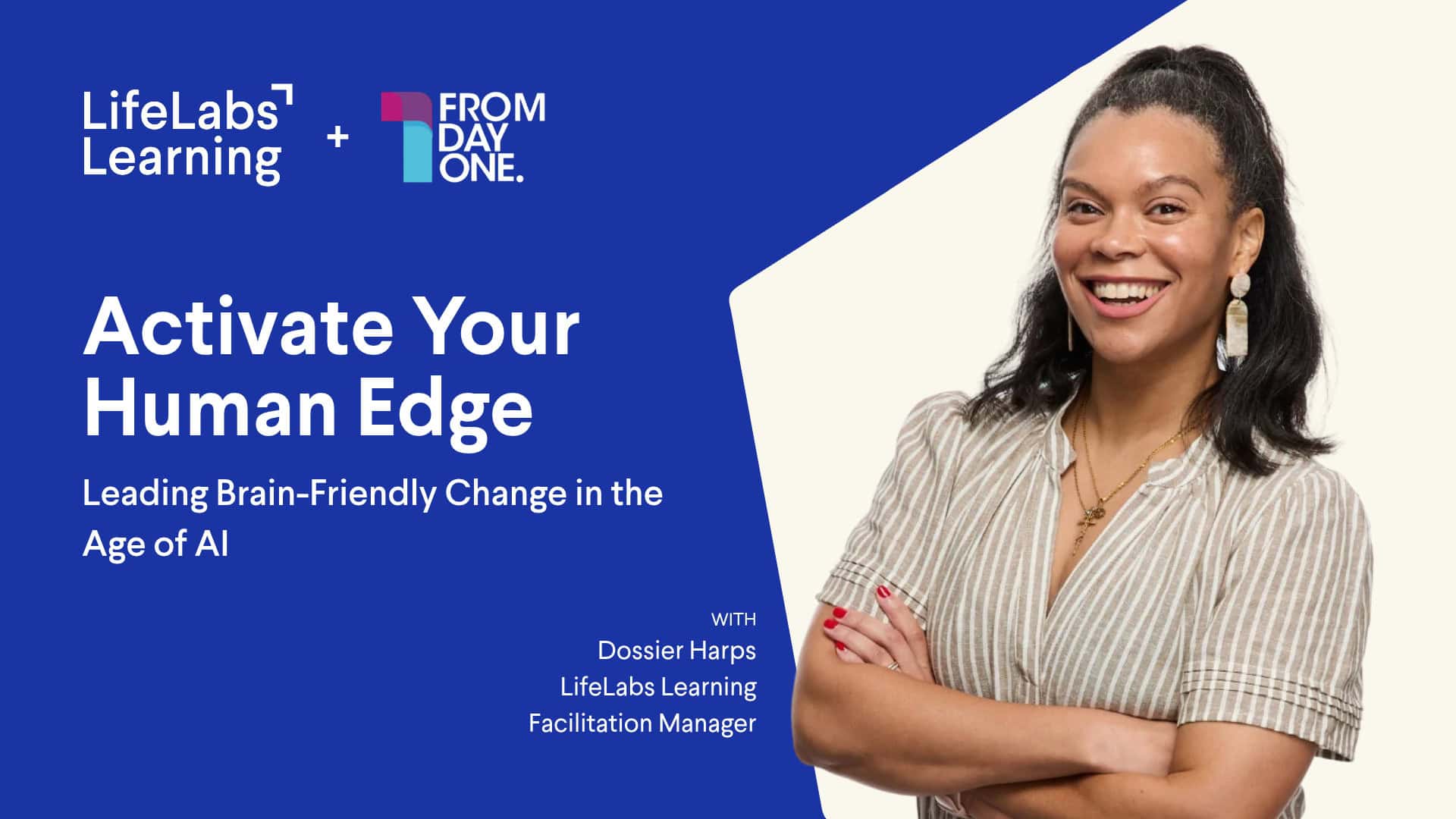
For more ways to help teams adapt, watch our on-demand session, Leading Brain-Friendly Change in the Age of AI, with Dossier Harps.
7. Building trust: help people speak openly about AI
Building trust means responding consistently and constructively when someone raises a question, flags an error, or says they’re unsure. One employee may worry about accuracy. Another may be wondering what AI means for their role. Managers need room to hear those different concerns and understand what’s behind them.
LifeLabs Learning teaches Surface the Shadow to help managers understand how employees are using AI and what support they need. Lead with curiosity: “What does this approach help you achieve?” Ask what feels unclear or makes sharing difficult. Thank people for explaining their process, then agree on a useful next step, such as clarifying an expectation or finding an approved tool that meets the need.
A manager might say, “I missed an error in an AI-generated summary last week. Here’s how I corrected it and what I’ll check next time.” Then invite input: “Where has AI made your work harder to check?” Listen, acknowledge the concern, and ask what happened without assuming the cause.
Caption: In this LeaderLab 2026 clip, Dossier Harps shows how managers can model the fuller story of AI use: what helped, what needed correcting, and when they chose not to use it.
What happens after someone speaks up matters. If checking AI output is crowding out other priorities, make room for it or adjust the workflow. If an employee asks about job changes the manager can’t answer, be clear about what’s known, what’s still undecided, and when to expect an update. Then make sure that update happens.
Which AI leadership skills should your organization prioritize?
| If your organization is experiencing… | Prioritize… | LifeLabs practice to try | Look for improvement in… |
| Employees accepting AI recommendations without examining the reasoning | Coaching | Q-Step | Evidence checking and decision quality |
| Unclear ownership or review expectations for AI-assisted work | Delegation | GEMS | Agreed owners, standards, and check-ins |
| AI experiments disconnected from business priorities | Strategic thinking | Link-up Check | Clear links between AI use and business goals |
| Overload despite faster drafting | Productivity and prioritization | Clear Then Steer | Realistic capacity estimates and workload agreements |
| Inconsistent quality in AI-assisted work | Feedback | Point-It-Out | Specific checking and correction behaviors |
| Confusion or friction around new AI workflows | Leading change | PACE | Shared standards, support, and integrated workflows |
| Employees keeping AI use or concerns to themselves | Building trust | Surface the Shadow | Earlier discussion of risks, needs, and useful practices |
How to build AI leadership skills across your organization
Give managers one shared practice they can try in a situation they already face. For an AI-assisted customer briefing, that might mean agreeing on ownership and source checks before work begins. Let managers practice that conversation out loud, get feedback, and try it at work. When they reconnect, ask what felt useful and where they got stuck.
The LifeLabs Learning AI Transformation Program helps managers build judgment about when to use AI, lead people in AI-enabled work, and guide adoption. The Program combines science-backed Tipping Point Skills™ with live, facilitator-led practice and Skills Lab, where managers apply skills from across the Program to real workplace challenges.
For teams building their management foundation, our Manager Core Program includes Coaching, Feedback, Effective 1-1s, Delegation, and a Skills Lab.
Frequently asked questions about AI leadership skills
What are AI leadership skills?
AI leadership skills are the capabilities managers use to guide people, decisions, and workflows as AI becomes part of work. They help managers clarify accountability, coach employees to evaluate recommendations, set quality expectations, and support teams through change. The seven skills in this guide give HR and L&D leaders a practical place to start.
How is AI literacy different from AI leadership development?
AI literacy includes understanding AI’s capabilities, limitations, and responsible use. AI leadership development focuses on how managers lead people and organize work involving AI. The two overlap: managers need enough understanding to recognize limitations and seek expert help, plus the skills to coach, delegate, and lead change.
How can HR and L&D prepare managers for AI adoption?
Start with a work problem managers and employees recognize. If ownership is unclear, focus on delegation. If recommendations are accepted without examining the reasoning, focus on coaching and qualified review. Choose a behavior managers can practice, provide feedback and workplace support, and measure whether the team’s practices improve.
How can organizations measure AI leadership development?
Define a target behavior and record a baseline before training. For delegation, sample work handoffs for an agreed owner, quality standard, and review plan. For coaching, use observation or practice reviews to assess open-ended questions and follow-up. Track relevant work outcomes, such as correction effort or missed handoffs, alongside those behaviors. Attendance, satisfaction, and AI usage add context; they don’t establish behavior change or prove training caused an outcome.
What training do managers need to lead AI transformation?
Managers need practical development in AI discernment, delegation, coaching, accountability, and leading change. Training should help them decide when AI is useful, clarify who owns the result, and coach employees through AI-assisted decisions. Give managers opportunities to rehearse the decisions and conversations they will encounter at work.
What should organizations look for in an AI leadership development program?
Look for a program that addresses everyday management challenges, teaches specific behaviors, and includes practice, feedback, workplace application, and measurement. For example, LifeLabs Learning’s AI Transformation Program combines science-backed Tipping Point Skills™ with live, facilitator-led practice and a Skills Lab where managers apply what they have learned to real workplace challenges.