Summary: Delegation is one of the fastest ways for managers to build team skills, engagement, and capacity. In this conversation, you’ll see where delegation tends to stall, how AI complicates the decision, and a few simple ways to make smarter handoffs in the moment.
We sat down with LifeLabs Learning facilitator Justin Balido, who works with managers every day to help them shift from doing the work to scaling it through others. In this conversation, Justin shares why delegation so often breaks down, how AI is changing the delegation equation, and what it takes to build teams that grow while getting great work done.
Q: What’s the biggest challenge managers face with delegation?
Justin:
A lot of managers are promoted because they were strong individual contributors. They’re used to seeing their value in their own output. But the real value of a manager is in scaling the success of their team. Otherwise, they become the bottleneck.
Delegation is a big part of that. And that mindset shift is often the biggest “a-ha!” moment.
Q: Delegation sounds simple, but it often breaks down in real life. What’s different about delegating well today, especially with AI in the mix?
Justin:
In theory, delegation is simply “the act of entrusting tasks or responsibilities to others.”
But it can break down in a few places.
There’s the “act” part – getting around to doing it.
The “entrust” part – actually letting go.
And the “tasks or responsibilities” part – figuring out what to hand off.
Sometimes it helps to step outside of work to see it clearly. For me, it’s the kitchen. I grew up cooking with my mom for big family parties. For her 60th birthday, we threw a surprise party, and I was suddenly on my own, prepping a meal for 50 people. I realized pretty quickly I should’ve figured out delegation a lot earlier.
First, the “act” piece. It didn’t even occur to me until my sister offered to help. Then, the “entrusting” piece. I hesitated to hand anything over because I didn’t trust others to do it the way we always had. And finally, the “what to delegate” piece. I couldn’t decide which tasks to give away.
That same pattern plays out for managers every day. And now, with AI in the mix, it’s even less clear. AI can’t make perfect oblique carrot cuts (yet), but it can handle a lot of the tasks managers used to delegate. So now the question isn’t just who to delegate to, but when to use AI and when to invest in your team.
If everything gets handed to AI, you miss the chance to build skills and judgment, leaving a lot of untapped potential on the table.
Q: What do you mean by “untapped potential” in delegation?
Justin:
Delegation at its best is an act of Give & Grow, a Method we teach in our Delegation workshop.
You give a task or responsibility to someone so they can grow (build a skill, gain visibility). And you grow too by freeing up time for more strategic work.
When managers default to AI instead of delegating to a person, they skip that growth piece. That shows up in two ways.
First, teams don’t build the skills they’ll need going forward. AI can help create a meeting agenda, but it can’t help you read the room. Research shows these human skills are in increasingly high demand. (And overreliance on AI can actually deteriorate them.)
Second, you miss an opportunity to increase engagement. Research shows people feel more engaged at work when they’re learning, growing, and contributing in new ways. Two of the biggest predictors for engagement are “I’m learning and growing” and “My manager cares about me and my development.”
So delegation today requires being more intentional. Are you handing something off just to get it done, or is there an opportunity to help someone grow?
Q: Is there a simple way to get better at spotting delegation opportunities?
Justin:
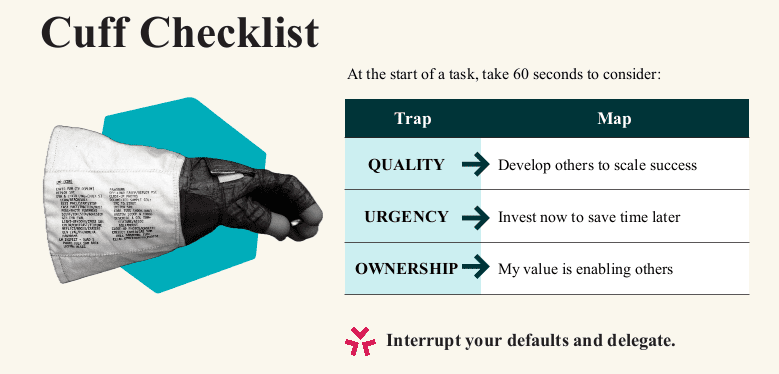
Yes. We teach something at LifeLabs called the Cuff Checklist, a 60-second mental pause at the start of a task.
It’s inspired by Apollo 11 astronauts who wore checklists on their cuffs for high-pressure situations. And while most workplaces aren’t as high-pressure as the surface of the moon (stakes-wise, not barometrically), the idea still applies.
Before deciding to hold onto a task, you pause and identify any default reactions, or “traps,” and replace it with a “map,” or way out.
The most common traps are Quality, Urgency, and Ownership.
Quality is “If I want it done right, I have to do it myself.”
Urgency is “I don’t have time to delegate.”
Ownership is “I’m happy to do it!”
Together, they spell QUO — like status quo. These are the patterns that keep you stuck being reactive. The checklist helps you catch that in the moment and choose differently, instead of becoming a multiplier of one.
You can go one step further by combining it with Give & Grow.
For example, a manager had to prepare a quarterly report for a VP. They put it through the Cuff Checklist and realized they were in the Quality trap and considered using AI to draft it. That would’ve been efficient. But when they thought about Give & Grow, they saw it as a chance for a direct report to build experience communicating with senior stakeholders. That’s an investment that pays off over time.
Q: What if a manager delegates a task to a team member, who then uses AI? How can managers ensure their team uses AI thoughtfully, rather than just handing work over?
Justin:
One of the most overlooked parts of delegation is reflection.
Before the task begins, managers can ask:
- How might you use AI for this?
- What could be streamlined with AI?
- What parts shouldn’t be delegated to AI?
This kind of coaching helps people think more intentionally about how they use AI.
After the task, most managers reflect on their own: Was this what I expected? Did I have to redo anything? Can I delegate this again?
Great managers pause and reflect with the person:
- What could I have done to set you up better?
- How did you use AI?
- How did you check its thinking?
That’s how they make sure learning actually happened, instead of AI doing all the thinking.
Q: If a manager tries just one thing this week to delegate more effectively, what would you suggest?
Justin:
Pick one task and run it through Give & Grow.
Be explicit about both sides. What are you giving? And how will this help the other person grow?
Then ask yourself how you’ll grow. What does this free you up to focus on?
It’s a small shift, but it changes how managers think about delegation, from offloading work to building capacity.