
What the Best Learning Launches Have in Common
Summary: Over the last year, attendance has become one of the biggest topics in our kickoff conversations with customers. It’s always been part of the planning process, but today it’s harder to build momentum around learning. Managers are navigating constant change, competing priorities, and calendars that feel permanently full.
Everyone wants to know: How do we make sure people actually show up?
Across thousands of launches, we’ve learned that what happens before the first session has an enormous influence on who shows up and what happens inside it. Our client success and support team often asks customers to pause before finalizing their launch plan and do a quick pre-mortem.
Imagine it’s six weeks from now, and attendance missed the mark. What happened? Managers forgot to mention the program. Calendars filled up. Employees didn’t understand why the learning mattered. Leaders talked about it once, then moved on.
A pre-mortem can help teams spot attendance risks early, while there’s still time to do something about them.
Many of the questions below come directly from client planning conversations. Asking them has a remarkable impact on whether a program is likely to build momentum before the first workshop ever begins.
Who will people hear about this from first?
Most organizations start planning a launch by drafting an announcement. But an organizational email isn’t enough. Research shows we’re influenced not just by the message itself, but by who delivers it. Your people are more likely to engage when they hear about a program from people with internal social capital who they respect, admire, or identify with.
That’s why we suggest you start by forming your rock band, or influential stakeholders. Whose voices naturally carry weight? Your executives, respected managers, long-tenured employees, influential peers? Bring those people in early. They’ll spot blind spots, shape stronger messages, and become champions for the program before registration even opens.
A tactic we’ve seen make an outsized difference is to ask managers to nominate their team members. A quick conversation during a one-on-one or a short personal note carries far more weight than a company-wide announcement because it signals that someone’s manager believes this time is worth protecting. And a personal invitation is much harder to ignore than a mass email.
Why should someone protect an hour or two for this?
One exercise we do with customers is to review the first announcement (and provide access to resources like templates and toolkits) they’ll send to participants. We read it from the perspective of someone who knows nothing about the program and ask: Would I understand why this deserves time on my calendar?
Most announcements explain the workshop logistics: the title, facilitator, date, and registration link. Important, yes, but these aren’t what help someone decide to protect time in the middle of a busy week. They want to know whether it saves them time or solves a problem they already have.
We’ve found it helps to write different benefit statements for different audiences.
- Managers want to know how the learning will give them time back and make their jobs easier by.
- Individual contributors are looking for skills that help with their career growth and can be used tomorrow.
- Executives want to understand how the investment supports broader business goals.
They’re all hearing about the same program, but they’re listening for different reasons. A strong announcement catered to difference audiences for different programs acknowledges those differences instead of assuming a single message will resonate with everyone.
| Every learning program announcement should answer three questions WHAT — What will participants get from the training? Why is the organization investing in this? WHO — Who should deliver the message so employees take it seriously? HOW — Where will people hear it, and how often? |
How many times will people hear about the program?
A single learning program announcement has a lot of competition in today’s information-overloaded workplace. It might come on the same week as open enrollment, a product launch, quarterly planning, or a big deadline.
A concept we borrow from advertising is effective frequency, which dates back to Thomas Smith’s book Successful Advertising, where he described how repeated exposure gradually moves people from not noticing a message to eventually acting on it. Give people multiple opportunities to connect the training to something that matters in their day-to-day work. That doesn’t mean sending the same email five times. You need to vary the messenger, the format, the channel, and the moment. Here are some ideas:
- Have an executive introduce the program during an all-hands meeting.
- Ask managers to reinforce it during team meetings.
- Send a Slack reminder to answer practical questions before the first workshop.
- Encourage participants from an earlier cohort to share how they’ve used one of the tools.
- Send a physical invitation
Each touchpoint builds on the last.
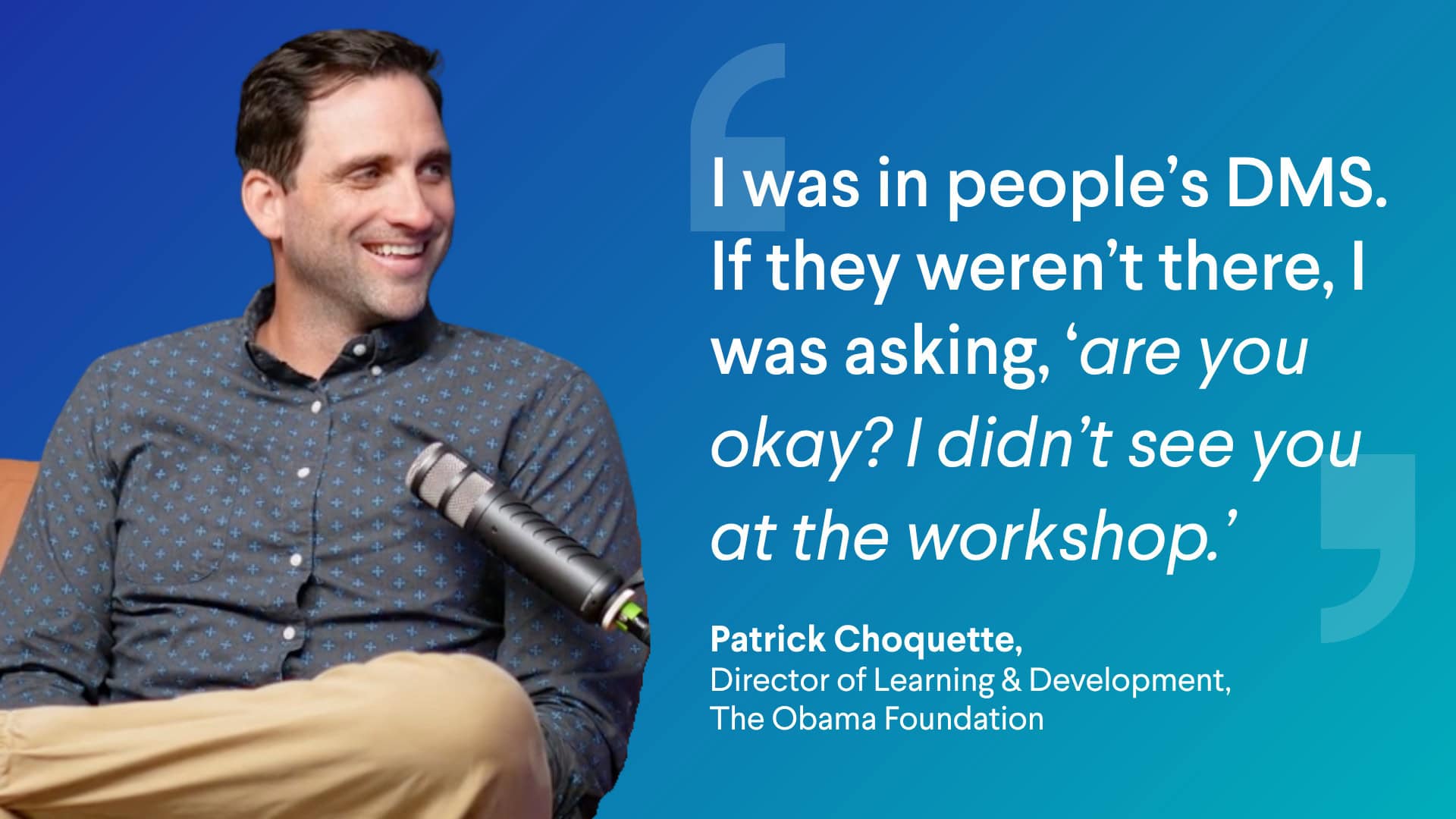
| In Practice: How the Obama Foundation Reinforced Learning On a recent episode of The LeaderLab podcast, Patrick Choquette, Director of Learning and Development at the Obama Foundation, shared that, instead of relying on calendar reminders alone to promote learning, he reinforced a single consistent message: your development matters. Here are a few ways he accomplished this: Managers experienced the learning first, so they could speak from experience.Leadership behaviors were built into performance expectations.When someone missed a workshop, Patrick reached out personally to help them join another session.Learning became part of how people succeeded at work, not something separate. The result: 85%+ overall workshop attendance |
How easy is it to say yes?
LifeLabs facilitators often explain behavior with a fruit bowl (if you know, you know). Here’s the gist: if you put a bowl of bananas and oranges in a public place, which tends to disappear first? Almost always the banana. Not because people love bananas more. Because they’re just a bit easier to eat.
Learning program attendance works the same way. Every extra step gives someone another opportunity to postpone participating. Behavioral research shows that tiny barriers (like complicated registration forms, limited session options, or confusing makeup processes) create friction that dramatically reduces participation, making it much easier to put learning off until “next time.”
For a strong learning program launch, remove as many barriers as possible. Make sure:
- Time is blocked on calendars early.
- Registration is simple.
- Expectations are clear.
- If someone misses a session, there’s a plan to help them rejoin.
What will managers do after the first workshop?
By the time the first workshop begins, managers shouldn’t be stepping into the process for the first time. The most successful learning programs we’ve seen involve managers before, during, and after. Encourage them to invite people individually, protect time on calendars, ask what someone learned during a one-on-one, and notice when a workshop gets missed.
| The 3A Launch Audit If you’re planning a learning launch this quarter, these are the questions we’d ask in our very first kickoff meeting. Announcement – Have we explained why this learning matters? – Does every audience have a benefit statement? – Is the announcement coming from someone employees trust? Attendance – Have we made attendance expectations clear? -Have managers personally invited participants? – Is it banana-easy to participate? Advertising – Will people hear about the program in multiple places? – Are we varying the messenger and medium? – Have we planned enough touchpoints to stay top of mind? |
The launch shapes everything that follows
One of the reasons we spend so much time talking about learning and development launches is that they influence much more than attendance. When people understand why the learning matters, they’re more likely to arrive ready to participate. Then, after the workshop, managers reinforce the same language, and teams begin using shared tools and behaviors.
That’s how learning stops feeling like an event on the calendar and drives organizational outcomes and starts becoming part of how people work together every day.
