
Summary: To get executive buy-in and budget for a companywide leadership development program, start with a business problem your leaders already want to solve. Bring in an executive sponsor and Finance early. Ask for funding for a first cohort, show the full cost, and agree on what you’ll measure before requesting budget to expand.
HR often sees a manager development need through the work that comes back to them, such as a performance conversation that keeps getting postponed, a delegation that leaves ownership unclear, or a new manager who needs help giving feedback. Those patterns may be familiar to the leadership team, too. The harder question is whether training will help, and what the organization needs to put behind it.
LifeLabs Learning’s Consultants help People leaders work through these decisions every day, from securing budget approval to finding time for training and navigating internal reviews. Their work often starts with helping teams define the problem they need training to solve.
What executives actually want to hear about leadership development
Your executive team has to weigh this request alongside other spending. Help them see which problem the training addresses and what you’ll check before funding the next cohort.
Make the connection to the work. “Managers will improve their coaching skills” leaves an executive to work out why that matters. You might explain that managers keep taking back delegated tasks when employees get stuck. Coaching practice would give them a way to help employees think through the problem and keep ownership of the work.
| Why prioritize manager development? LifeLabs Learning’s 2026 Mid-Year Workplace Trends Report points to specific gaps: 56% of respondents rated managers’ coaching and feedback capability at 5 out of 10 or lower.72% identified monitoring, follow-through, and check-ins as the hardest part of delegation. Use these findings to start an internal conversation. Where do your managers get stuck, and what does that cost your teams in repeated follow-ups, unclear priorities, or HR escalations? |
How to build and present the business case
Before you put a proposal in front of the executive team, find out what each decision-maker needs to see. Finance may want to check the assumptions behind your estimate. A department lead may need to know who will cover the work while managers are in training. Their questions can help you shape the proposal before the meeting.
Step 1: Define the problem
LifeLabs Learning consultants often start with the Gap Check, a strategic thinking Behavior that helps teams agree on what success looks like and measure how far they are from it.
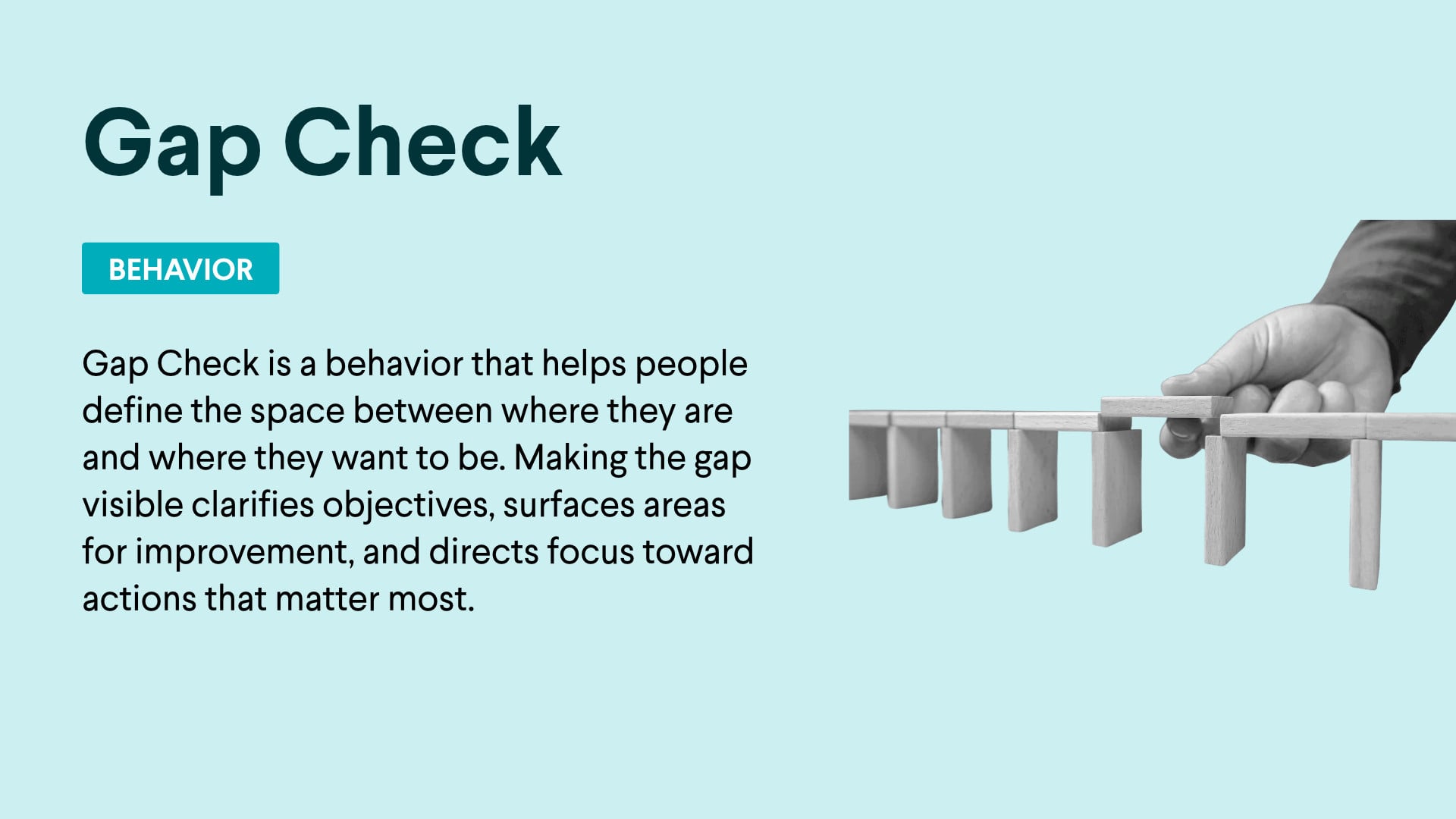
Say you want 80% of employees to report that their manager’s feedback helps them understand what to do differently. If 60% say that today, you have a 20-percentage-point gap. Survey comments and recurring requests for HR support can help you understand where managers get stuck and what they could practice.
Bring the baseline and proposed target to your executive sponsor while there’s still time to shape the plan together. Agree on an early sign to watch. For example, are managers ending feedback conversations with a specific next step? Check for that in a short employee pulse survey so you can adjust the practice if needed. Then revisit the original survey question at the review date you agreed on and use the results to decide whether to fund another cohort.
| AN EXAMPLE How Huntress made 1:1s more consistent The problem: Huntress, a fast-growing cybersecurity company, needed a more consistent approach to 1:1s. The solution: Managers practiced coaching and feedback in live LifeLabs Learning Workshops. They learned a shared 1:1 structure and reinforced new skills with a manager playbook. The results: Within four months, employee survey scores for goal clarity rose 15 points, and coaching and feedback scores rose 8 points. 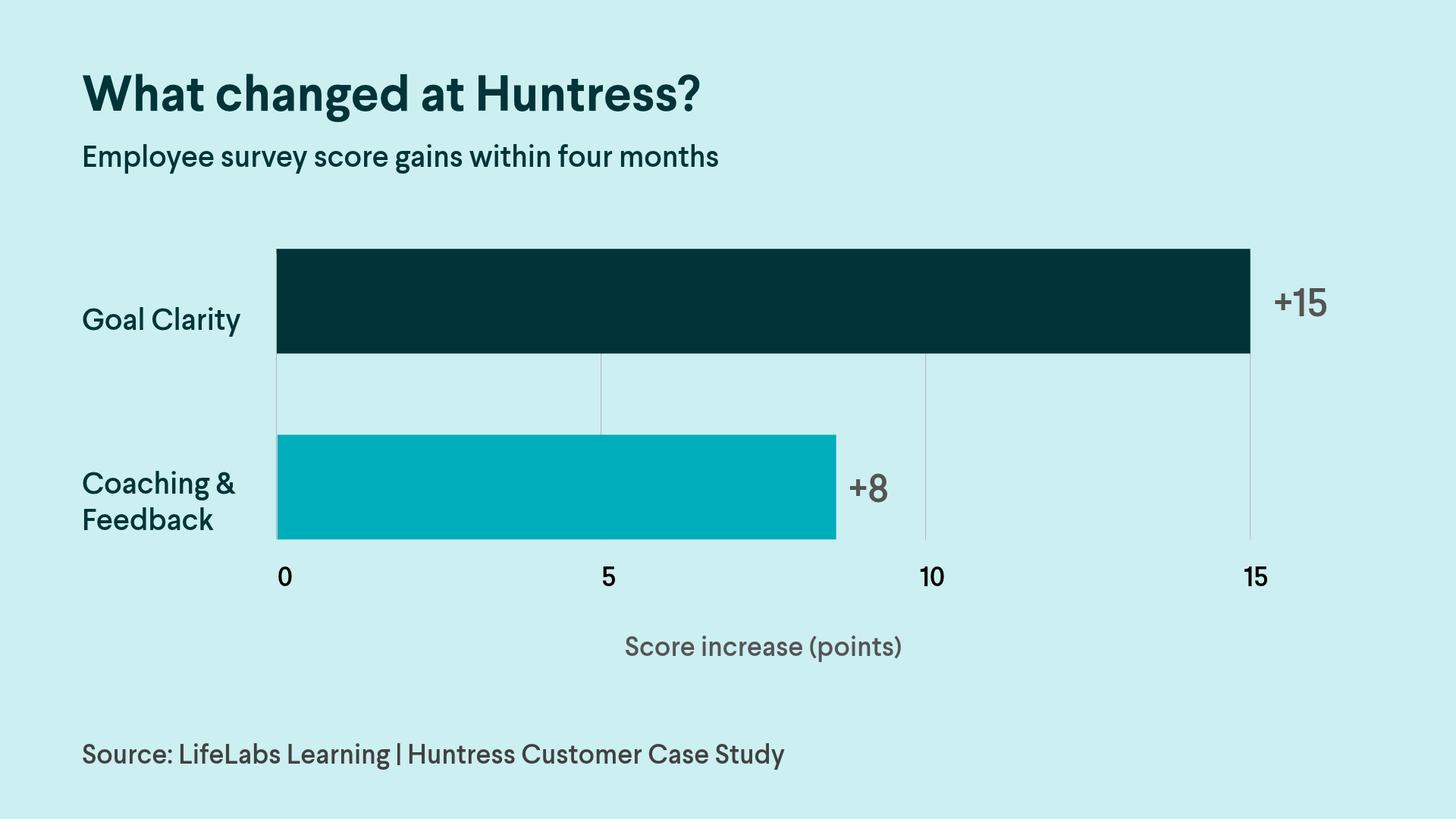 The takeaway: For a buyer, the useful detail is how Huntress supported the learning between sessions. The shared 1:1 structure gave managers somewhere to use what they practiced. Ask a potential partner how that follow-through would work in your organization and who would need to support it. |
Step 2: Propose a phased rollout
Ask for a decision on the first cohort. Agree up front on what would justify adding another group and what would tell you the program needs more work.
Start with the group closest to the problem. If employees leave 1:1s unsure of their priorities, a manager cohort focused on coaching, feedback, delegation, and manager conversations may be a useful first step. LifeLabs Learning’s Manager Core is one option for building those shared practices. Expansion should follow evidence from that cohort and the needs of the next group.
Step 3: Quantify expected returns
Translate expected outcomes into financial language using costs Finance can help you check.
For example:
- Teams in the pilot spend 10 hours a month redoing work after unclear handoffs.
- After delegation training, managers cut that rework in half through clearer expectations.
- The teams would get 15 hours back over a quarter.
Ask Finance how it would value that time. Include the program’s full cost, including participants’ time, and be clear that this is a scenario you’ll test.
If you include an ROI estimate, show Finance how you arrived at it. A range with clear assumptions gives them something they can question and refine with you. Also discuss what another quarter without training could mean for the problem you’ve identified. For example, how much time do HR and senior leaders spend resolving conversations managers could learn to handle? Use your own data to make the case for timing.
What managers will practice and use at work
A manager can understand the principles of feedback and still get stuck in a difficult conversation. Look for training that gives them time to rehearse that moment, hear another perspective, and try the conversation again. That’s practice they can draw on when the stakes feel higher at work.
Ask a prospective provider to share a practice activity. Will managers work on a conversation they actually need to have? Will they get feedback and another try? LifeLabs Learning’s learning design pillars describe how it teaches Tipping Point Skills™ through relevant scenarios and small behaviors people can use at work. Its Programs also include Skills Lab, a live, facilitator-led capstone for further practice.
Include opportunities for learners to practice and apply skills they’ve learned in training to real-world workplace situations when you compare proposals, along with the workshop topics and price.
For example, after a delegation workshop, a manager might try setting a clearer check-in plan for one project. Their own manager can follow up in a 1:1: “How did the handoff go? Where did you need to step back in?” That conversation helps them work out what to adjust next time.
How to get through multiple approvals without stalling
An executive sponsor can back your proposal while Finance reviews the budget and procurement needs time to run a formal bid. LifeLabs Learning’s Inclusive Planning Check helps you spot where those decisions could hold up the work. Break your proposal into five phases, then map who should help shape the decision, who needs to sign off, and when to bring each person in.
Ask: Who should be involved at each stage of this plan? Am I under-involving or over-involving anyone?
Sample Inclusive Planning Check for a manager training pilot
|
Phase 1 Analyze Problem |
Phase 2 Define goal |
Phase 3 Brainstorm solutions |
Phase 4 Pick solution(s) |
Phase 5 Execute |
|
|---|---|---|---|---|---|
| You | X | X | X | X | X |
| Your manager | X | X | |||
| Execs | X | X | |||
| IT | X | ||||
| Procurement | X |
Mark an X wherever someone needs to be involved. In this example, executives help define the goal and choose a solution, while IT and Procurement weigh in before selecting a provider. If Procurement needs to run a formal bid, move its first X earlier so you can plan around that requirement.
Measuring what matters: Metrics that keep executives engaged
Attendance and workshop ratings tell you who showed up and how they experienced the training. To decide whether to fund another cohort, look for changes in the work that prompted the proposal.
Behavior change indicators
Track observable shifts in how managers and employees operate. Are managers conducting regular one-on-ones? Are feedback conversations happening more frequently? Are team meetings producing clear action items? A follow-up question such as “Did your last 1:1 help you get clear on priorities?” can tell you more about skill use than a workshop rating alone.
Business outcome metrics
Connect program participation to outcomes executives already track:
- employee engagement scores
- voluntary turnover rates
- internal promotion rates
- time-to-productivity for new managers
- team performance indicators
Consider what else changed during the same period, such as team structure or compensation, before attributing a result to training.
Leading indicators for early wins
Identify leading indicators you can report within 30 to 90 days, like participant confidence scores, behavioral commitment tracking, manager self-assessments, and direct report pulse surveys.
LifeLabs Learning’s centralized learning platform gives L&D teams real-time reporting on workshop attendance, feedback, and ratings to help teams track participation and the learning experience. Before choosing a partner, ask which reports they provide and which follow-up measures your team will need to collect. Direct report pulse surveys can help you check whether managers use the skills at work.
Sharing early behavioral evidence with executives keeps the program visible and builds the case for continued investment. Report results in the same language you used to pitch the program: reduced risk, improved performance, measurable behavior change.
How to move from proposal to companywide impact
You can start this conversation before you have a finished proposal. Choose a problem your executives are already trying to solve and ask a potential sponsor to help you think it through. Their questions will tell you where the case needs more work.
What to bring to Finance
A useful first draft can fit on one page. Include:
- The problem and baseline. What needs to change, and where are you starting?
- The pilot group. Who will participate, and why start with them?
- What they’ll practice. Which skills will managers use on the job?
- The full cost. Include program fees and participants’ time.
- The next funding decision. What result would justify expanding, and when will you review it?
Leave room to adjust it as you learn.
Need help scoping the proposal? To discuss which cohort to start with, what managers need to practice, and how to support application, book a call with a LifeLabs Learning Consultant.
FAQs about executive buy-in for leadership development
Why do executives hesitate to fund leadership development programs?
Executives may have questions about cost, time away from work, or whether managers will use what they learn. Ask which concern is holding up the decision, then address it in the proposal.
How do you calculate ROI for a leadership development program?
ROI compares the financial benefit attributable to a program with its total cost: (benefit − cost) ÷ cost × 100. Work with Finance on the assumptions, including participant time and administration. Report behavior changes alongside the calculation; an engagement score or confidence rating does not have a dollar value on its own.
What is the difference between manager training and companywide leadership development?
Manager training focuses on building skills for people in management roles, such as coaching, feedback, and delegation. Companywide leadership development extends these skills to individual contributors, building shared practices around communication, collaboration, and adaptivity. LifeLabs Learning offers Manager Core for managers and Workplace Core for individual contributors and teams. Choose the starting group based on where the problem shows up, then use the first cohort’s results to guide expansion.
How long does it take to see results from a leadership development program?
A manager can try a new feedback method like LifeLabs’ Playing Cards Method™ in their next 1:1. Seeing whether that changes employees’ experience takes follow-up, and outcomes such as retention require a longer time horizon. Agree on review dates that fit the skills and outcomes you’re tracking. Starting with leading indicators like participant confidence and behavioral commitments helps demonstrate early progress to executives.
How do you keep executives engaged after they approve the program?
Share quarterly impact reports that combine data with specific stories of behavior change. Involve executives as visible sponsors who participate in program events and champion development in leadership meetings. If you’re evaluating LifeLabs Learning, ask to see sample reports and discuss how your team will gather evidence of skill use between workshops. Agree on the next funding decision and what evidence executives need to make it.