Summary: Delegation shapes how work, ownership, and growth are distributed across a team. Yet many managers hold onto tasks due to habits around control, speed, and responsibility, which can limit development and create bottlenecks. With a few intentional shifts, delegation becomes a way to build capability, increase engagement, and expand team capacity.

Delegation is often framed as a productivity tactic, but it affects far more than a manager’s workload. It shapes how opportunity, responsibility, and capability develop across a team.
When managers hold on to too much work, employees miss out on chances to build skills, expand their impact, and grow into the roles they want next. Thoughtful delegation opens access to work that can stretch someone’s capabilities or connect their efforts to something bigger.
That matters because meaning isn’t just about the task itself. It comes from how people interpret their work: whether it helps them grow or contributes to something they care about. A large meta-analysis published in the Journal of Management Studies shows when people experience a sense of meaning, they’re more engaged, more satisfied, and more likely to stay.
Delegation is one of the simplest ways managers can shape that experience. By aligning work with someone’s development goals or making the impact of their contributions more visible, managers turn everyday tasks into opportunities for growth and connection. And because managers influence how work gets distributed, even small shifts here can ripple across a team.
Why delegation feels difficult for many managers
If delegation creates so much value for teams, why do managers still hold onto work? Behavioral science offers an explanation: managers often fall into predictable mental traps.
They tell themselves things like:
- “If I want it done right, I should do it myself.”
- “Explaining this will take longer than doing it.”
- “I’ll just take responsibility for this one.”
These reactions are common because delegation involves risk. The outcome may be uncertain, someone else might approach the work differently, or the manager may feel accountable for the result. Sometimes managers simply enjoy the work they’re holding onto.
Research helps explain these patterns, highlighting how guilt, perfectionism, or a desire to maintain control can make leaders hesitant to hand off work. Left unchecked, these instincts turn managers into bottlenecks. Work builds up around them, fewer opportunities get shared with others, and the team’s leadership capacity stops expanding.
What behavioral science suggests managers should do instead
Most leaders already know they should delegate more. The challenge is acting on that intention during a busy workday.
Research on implementation intentions offers a useful approach. Psychologist Peter Gollwitzer found that simple “if–then” plans help people follow through on intended behaviors by linking a situation to a specific response.
For managers, that might look like:
If I feel the urge to keep a task…
then I pause and consider who could grow from owning it.
That short pause interrupts habitualized thought patterns and creates space for a more deliberate leadership choice.
The behaviors that help managers delegate more effectively
At LifeLabs Learning, we translate research insights into leadership behaviors managers can practice in everyday work. The Delegation Tipping Point Skill™ includes several of those behaviors, like the ones shared below.
Behavior: Spot the mental trap
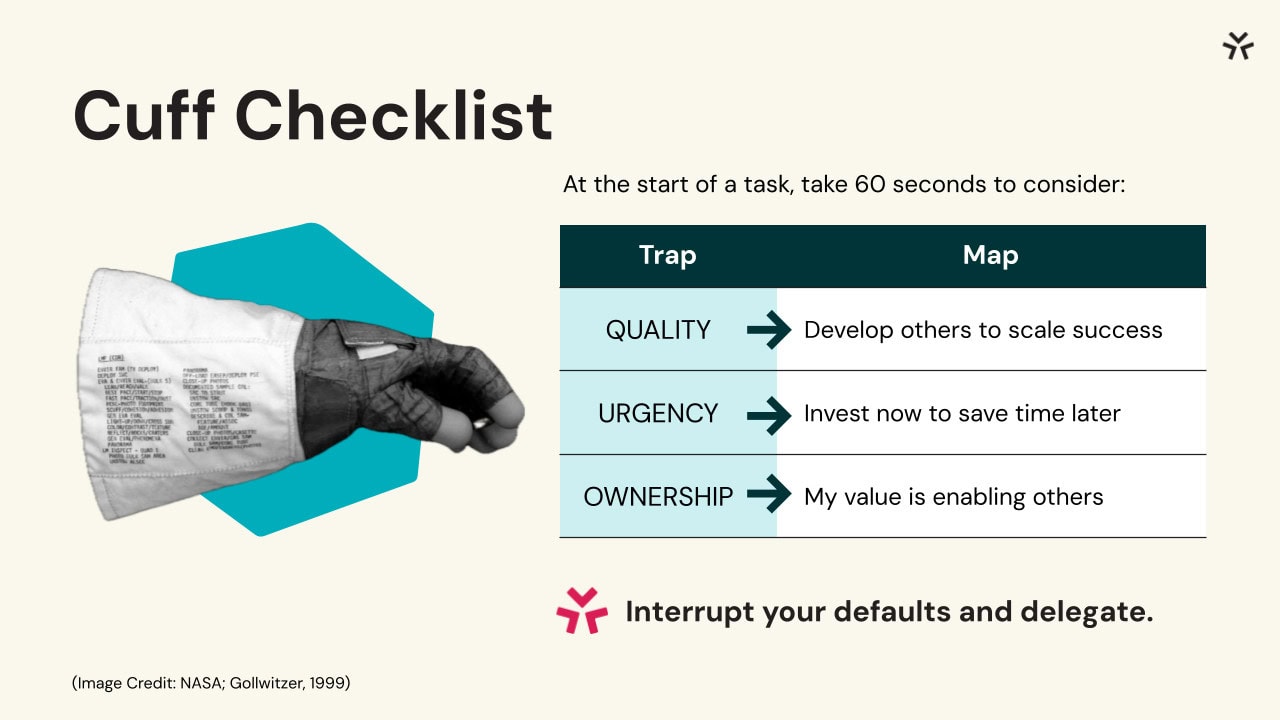
Delegation often breaks down when managers fall into predictable thinking patterns around quality, urgency, or ownership. Pausing to identify their mental trap helps leaders step out of the instinct to hold on to work and reconsider how sharing responsibility might help someone else develop.
In our Delegation workshop, we teach a method called the Cuff Checklist. Inspired by astronaut checklists used in high-stakes environments, it prompts leaders to pause and ask:
- Am I keeping this because of quality concerns?
- Because of urgency?
- Because I feel responsible for the outcome?
This brief interruption shifts decision-making from instinct to intention.
The Cuff Checklist builds on Gollwitzer’s research on implementation intentions, using simple “if–then” plans to help people follow through in the moment.
You can make it even more effective by giving it a physical home. A sticky note on your laptop. A quick calendar nudge. A one-line prompt at the top of your to-do list. These small cues act as a tap on the shoulder right when a mental trap is most likely to show up, creating a visible trigger that interrupts the default pattern and nudges a better choice.
Over time, those tiny interruptions start to reshape the habit itself, making thoughtful delegation feel more automatic rather than forced.
Behavior: Choose work that supports growth
Delegation becomes more effective when managers consider not just the task, but the development opportunity it creates.
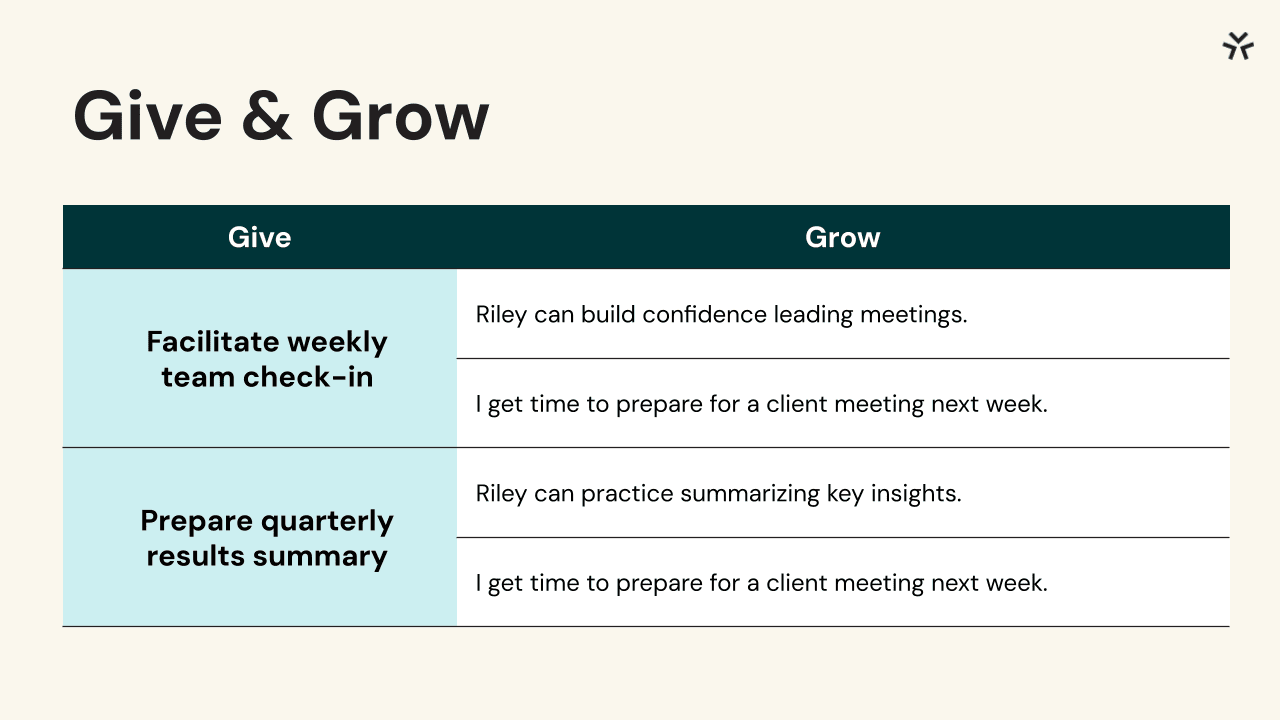
In the workshop, we introduce a method called Give & Grow. Instead of asking only “What should I delegate?” managers also ask:
- How can this help someone else grow?
- How will delegating it help me grow?
This approach aligns business needs with employee development. It also leads to better decisions. When you compare delegation options side by side, you can prioritize the ones that create meaningful outcomes for both you and the other person. And if you can’t clearly see how someone would grow, it’s a useful signal to pause. Maybe it’s not the right task to hand off yet.
The Give & Grow lens changes how you communicate the work, too. When you can name the growth opportunity, it’s easier to connect the task to what someone cares about, building motivation and helping them find more meaning in the work itself.
Behavior: Structure the handoff clearly
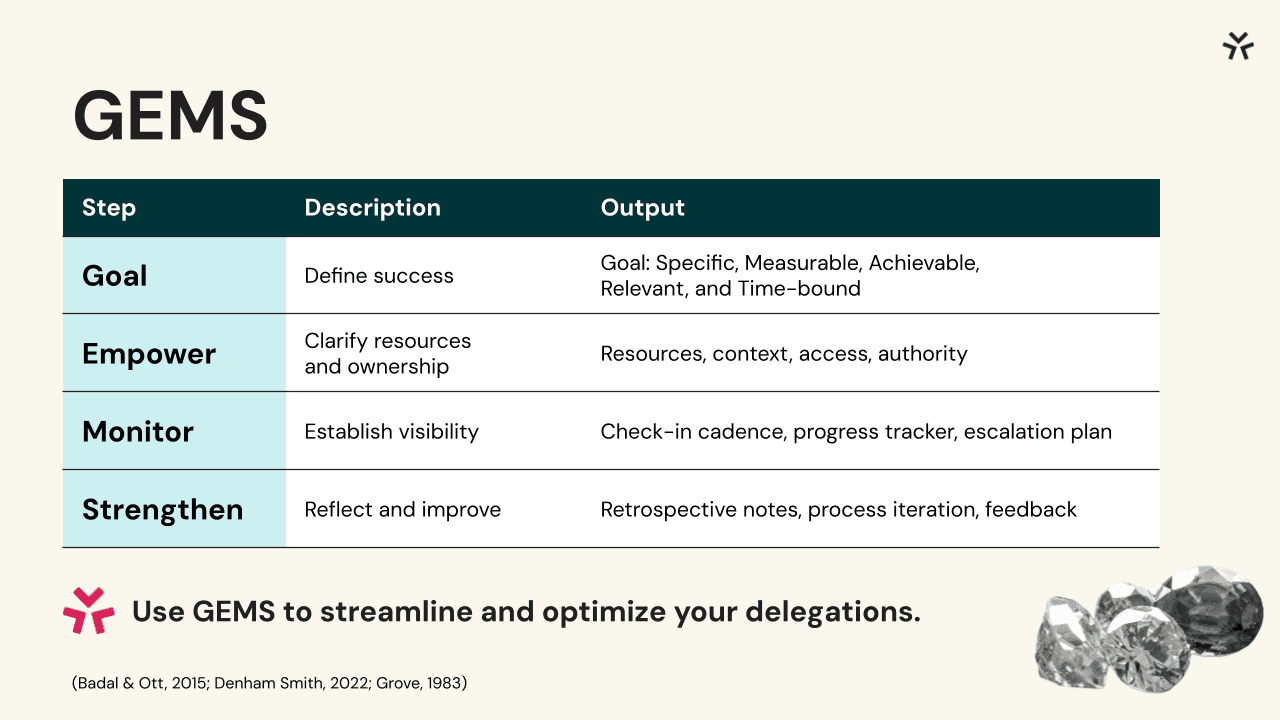
Delegation often fails when expectations are vague. We teach a method called GEMS to help leaders structure the handoff.
GEMS stands for:
Goal – Define success
Empower – Clarify resources and ownership
Monitor – Establish visibility
Strengthen – Reflect and improve
Gallup research shows employees struggle to execute delegated work when they lack role clarity or access to the resources needed to succeed. At the same time, leaders often hesitate to fully empower others due to guilt, perfectionism, or a desire to maintain control.
A structured handoff like GEMS addresses both challenges by making expectations, authority, and support explicit.
The Monitor step is especially important. Former Intel CEO Andy Grove argued that managers should “delegate what you know best.” When leaders understand the work deeply, they can spot risks early, ask better questions, and provide meaningful coaching. Grove also warned that “delegation without follow-through is abdication.”
Clear checkpoints help managers stay connected without hovering. Progress is visible, and ownership stays with the person doing the work. They also reduce the pull toward “delegation in name only,” where tasks quietly drift back to the manager due to quality or speed concerns.
A simple cadence replaces that instinct with clarity. When everyone knows when and how to check in, communication gets easier. Managers get out of the mental swirl, and teams know exactly how to keep things moving forward.
Together, these practices turn delegation from a vague request into a repeatable leadership habit that builds capability across a team.
Behavior: Step back so others can lead
Delegation doesn’t end once a task is assigned. Leaders also need to create space for others to take ownership.
Small behaviors signal that trust:
- asking open-ended questions instead of giving immediate answers
- allowing team members to make decisions
- inviting someone else to lead a meeting or discussion
Daniel Coyle’s work on team culture highlights how everyday leadership behaviors — like asking questions, inviting input, and stepping back — send powerful signals of trust.
Our workshop helps leaders Step-Back strategically, allowing team members to gain confidence, experience, and the opportunity to develop their own leadership skills.
What science-backed leadership development means at LifeLabs Learning
At LifeLabs Learning, science-backed means translating research into behaviors leaders can practice in everyday work.
Instead of focusing on personality models or abstract frameworks, we focus on observable actions leaders can repeat and refine. Methods like the Cuff Checklist, Give & Grow, and GEMS help managers turn delegation from a good intention into a consistent leadership habit.
When leaders delegate more intentionally, teams gain access to meaningful work, organizational capacity expands, and managers create space to focus on higher-level priorities.
FAQ
Why do managers struggle with delegation?
Most don’t lack awareness. They fall into quick, instinctive habits like “I’ll do it faster” or “I need to make sure it’s done right,” which makes holding onto work feel easier in the moment. Moreover, many new managers have delivered value throughout most of their careers by completing tasks. Effective management necessitates a rewiring of what “delivering value” looks like, with great leaders becoming orchestrators of team performance rather than solo performers.
What’s the real cost of not delegating?
Work piles up around the manager, while team members miss out on opportunities to build skills, confidence, and ownership.
What does effective delegation actually look like?
It’s clear and intentional. Managers define what success looks like, provide the right support, and stay connected to progress without taking the work back. Effective delegation extends well beyond the handoff. Managers create touchpoints to stay connected and to continue iterating on and improving the delegation process.
How can managers delegate in a way that develops their team?
By choosing tasks based on growth potential, not just efficiency. The question shifts from “Who can do this fastest?” to “Who could grow from owning this?” It’s also a way to identify “should I be handing this off to AI or will my team benefit from taking this on?”
What’s one simple habit to improve delegation right away?
Pause before keeping a task and ask: “Who else could take this on and benefit from it?” That small moment of reflection helps break the default to hold on.