Summary: Career growth conversations become more meaningful when managers stop focusing on the next role and start helping employees understand what growth means to them. Career development is one of the biggest expectations employees have of their managers, and one of the areas where many managers feel least prepared.
After a record turnout at our recent Career Growth Culture Club events, we sat down with Facilitation Manager Dr. Dossier Harps, EdD, to talk about modern career development and how HR leaders can better equip managers. She shared her curiosity-driven approach and one practical Method from the session: Know Your SEO.
Q: Career growth has become a bigger priority for employees, but many managers still struggle to coach those conversations. What are you seeing?
Dossier: I think one of the biggest mistakes we make is assuming career growth means the same thing to everyone. Career growth is deeply personal. Two people can have the exact same job title and experience completely different levels of fulfillment, challenge, and growth.
Sometimes managers feel like they have to come to a one-on-one with the next opportunity already mapped out. What I encourage instead is curiosity. Managers should ask direct reports what growth means to them. Not what they feel they should want. Not the path that seems most impressive. What actually matters to them personally.
We all absorb messages about what success is supposed to look like. Other people’s career stories can inspire us, but without taking time to understand our own values and priorities, inspiration can quietly become a comparison. Growth is far more meaningful when it’s aligned with who you are, not who you think you’re supposed to become.
Once managers understand someone’s values, priorities, and circumstances, it’s much easier to support their development in a way that aligns with their idea of career growth.
Q: You also challenge the idea that career growth always means climbing the ladder. Why?
Dossier: For some, career growth still means leading larger teams. For others, it’s becoming a subject matter expert, expanding their influence, building new skills, or finding work that better aligns with their values and lifestyle. In fact, one study by Robert Half found that 40% of Gen Z professionals would like a promotion that doesn’t involve becoming a manager. Similarly, research from Aerotek found that 41% of job seekers have no interest in pursuing management roles, citing factors such as work-life balance, flexibility, and a preference for contributing without managing people.
These trends don’t suggest that the career ladder has disappeared. Rather, they remind us that the ladder no longer looks the same for everyone.
That’s why I define employability as your ability to create value in a changing environment. It’s the combination of your skills, your relationships, your adaptability, and your commitment to continuous learning.
I often think of career development like rock climbing. Sometimes your next move is up. Sometimes it’s sideways. Sometimes you pause to build a new capability before making your next move. Progress isn’t always vertical, but it should always be intentional.
Q: One of the behaviors you teach is called Know Your SEO. What does that look like in a manager conversation?
Dossier: SEO stands for strengths, energizers, and opportunities. I compare it to the search engine optimization you might see in marketing. When you search online, you’re using keywords to find what you’re looking for. Your strengths, energizers, and opportunities become those keywords for career development. They help people identify opportunities that fit them, and they help managers understand where someone is likely to do their best work.
I encourage managers to talk to their direct reports about their SEOs. Ask them:
- What strengths come naturally to you?
- What kind of tasks and topics energize you and give you a sense of purpose?
- What knowledge and skills gaps stand in the way of opportunities that align with your career priorities?
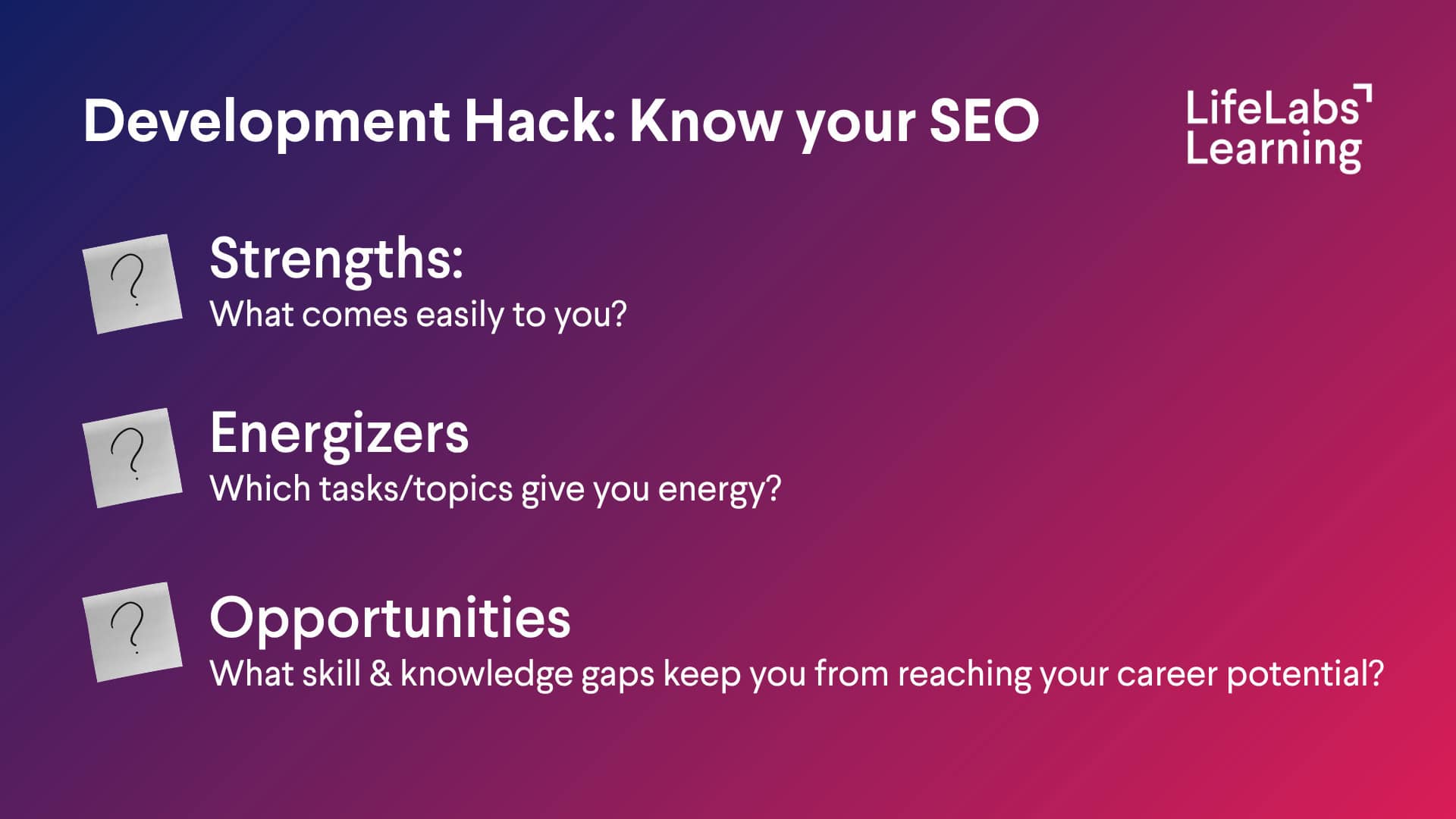
Those conversations move managers beyond job titles and into what actually motivates someone. Once you understand someone’s SEO, you can start matching people with projects that build on their strengths, stretch the skills they want to develop, and support the career they’re actually trying to build—not the one you assume they want.
Q: AI is changing how people think about career development. How should managers approach that?
Dossier: AI is changing the work itself, which means it’s changing career development, too.
I recently read a line that stuck with me: AI won’t replace jobs, but people who know how to use AI may replace people who don’t.
Whether or not you agree with that completely, the point is the same. Growth today includes learning new technologies and staying adaptable.
The opportunity for managers isn’t to have every AI answer. It’s to help employees keep asking, “What skills do I need to stay valuable in a changing environment?” At the same time, AI doesn’t replace the human conversation. It can’t tell someone what energizes them. It can’t help them define success.
Q: Self-advocacy comes up a lot during career conversations. Why is it such an important skill?
Dossier: Early in my career, I thought self-advocacy meant bragging, and I really struggled with it. Looking back, I realize we all have different relationships with self-advocacy. Our personality, culture, upbringing, past experiences, and even the workplace we’re in can shape how comfortable we feel talking about ourselves. None of those perspectives are inherently right or wrong, but they are worth understanding.
Early in my career, I learned an important lesson about self-advocacy. A casual conversation with a senior leader about my certifications and professional interests unexpectedly led to a career-changing opportunity. I wasn’t trying to sell myself. I was simply being honest about what I enjoyed and where I could contribute.
That experience reshaped how I think about self-advocacy. It’s not bragging; it’s providing others with the information they need to recognize where your strengths can make an impact.
There’s an important difference between humility and hiding, just as there’s a difference between speaking confidently about your contributions and exaggerating your value. Healthy self-advocacy is about giving others enough information to recognize where your talents, interests, and experience can create value.
That’s why I encourage managers to normalize self-advocacy during development conversations. Help people reflect on what they’re good at, what energizes them, and where they’d like to grow. People can’t connect someone with opportunities they don’t know they’re ready for.
Q. What role should managers play in career development, and how can HR better support them?
Dossier: One thing I see is that people often don’t know what they want. Managers sometimes feel pressure to have the next career step figured out for their employees, but that’s hard to do if the employee hasn’t defined what growth means to them.
I think of it as a Two-Hander:
On one hand, the employee’s job is to get clear on what they want.
On the other hand, the manager’s job is to help them get there.
That might mean introducing them to the right people, helping them identify stretch projects, or removing some of the mystery around how opportunities happen inside the organization.
When HR gives managers practical tools like Know Your SEO, managers have a better way to start those conversations. They don’t have to have all the answers. They just have to help employees discover where they want to grow.