
Summary: As work rapidly evolves, agility and resilience are essential. This blog shares four research-backed techniques to build adaptive teams that can navigate change, setbacks, and stress effectively. From reframing language to embedding microstructures like the Pomodoro method, these simple strategies help teams grow stronger over time. Learn how to normalize resilience, create structure within ambiguity, extract learning from challenges, and adapt communication to foster psychological safety.

Why resiliency training at work matters now
Agility training is often associated with sports, but it’s also a critical workplace skill, especially in 2025’s landscape of rapid change. If we think about the general concept of agility training — being able to stop, start, and change direction quickly while maintaining proper posture — it translates surprisingly well to the rapidly changing workforce we’re faced with today.
According to McKinsey’s Talent Trends survey, only 16% of global employers currently invest in adaptability and continuous-learning programs, yet 26% of employees say adaptability is a top skill they need. This mismatch shows many organizations are underprepared. There’s a clear need to ramp up resiliency training so employees feel equipped to handle change.
Here are four ways you can build a more agile and adaptable team:
1. Normalize resiliency conversations
We can learn a lot from nature, in this case, from one specific experiment called the biodome. A large glass dome was constructed in the desert to house an artificial, controlled environment with purified air and water, healthy soil, and filtered light. The intent was to afford perfect growing conditions for trees, fruits, and vegetables, as well as humans, which it did, with one exception. When the trees grew to a certain height, they would fall over. Researchers were puzzled by this until they realized they forgot to include the natural element of wind. Without wind, trees can’t develop their “stress wood,” which actually allows them to grow taller and stronger. Without it, they topple over.
Think of normalizing adaptivity as building your team’s “stress wood.” Encourage your direct reports to talk about their frustrations each week, and share yours with them as a way to create transparency around the struggle. Exposure to these stressors will only make them more resilient in the long run.
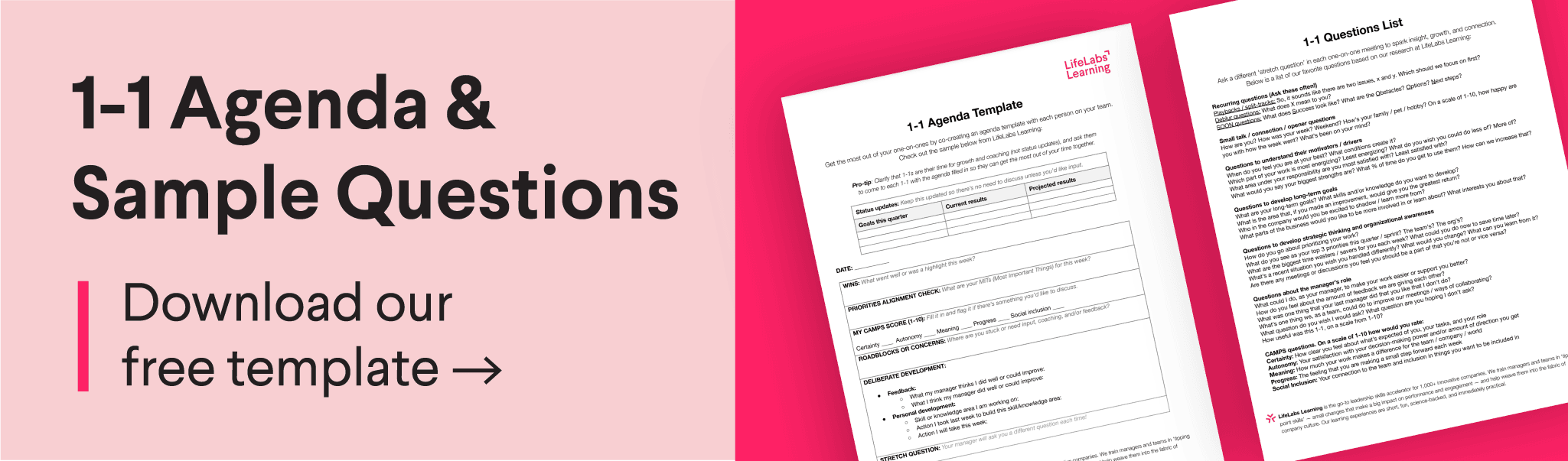
Try this: Add a section to your 1-1 meeting template that asks employees to record both their wins and setbacks from the week, and then spend time going over them both equally in your meetings.
2. Use “pseudo structure” to anchor teams during change
As humans, we crave both structure and freedom — a phenomenon known as prospect-refuge theory. We need the openness of possibility with the promise of safety, like an open field that feels endless, but still has a fence to keep out intruders.
In the midst of chaos, long-term success can feel like a reach, but small wins are still possible. Small achievements, like crossing one task off your to-do list, can give someone a surge of dopamine, giving their brain a reward and inducing a feeling of happiness.
Try this: Utilize the Pomodoro method to create small moments of “structure” throughout the day. Here’s how to do it:

3. Turn setbacks into learning with extraction skills
We’ve talked about extraction skills on the LifeLabs Learning blog before, but the basic concept of this superlearning skill is making learning stick. If setbacks and challenges occur, they can serve as excellent learning opportunities, as long as you’re actually taking the time to extract the key takeaways from these struggles and optimize for the future.
Try this: Building on the action item from step one, you should also add a learning extraction section to your meeting agendas and 1-1s. When it’s on the agenda, it normalizes it as a part of your team culture. This way, instead of just listing your wins and failures of the week, you’re opening up space to dive in a little deeper. Jot down notes, come up with a learning summary, and make sure the takeaways really stick.
4. Reframe setbacks with adaptive language
Word choice is a powerful thing, and the way you talk about setbacks can set the emotional tone for how your team receives feedback. We know that emotions are contagious, and the language we use has a lot to do with how positive or negative emotions carry throughout your team.
Try this: Change the language you use when responding to failure with your team. For example, instead of telling someone, “that doesn’t work,” try saying, “we have to do another iteration on that one.” Creating space for possibility and improvement rather than giving a hard “no” makes others more receptive to feedback and builds adaptivity.
Frequently Asked Questions
What does it mean to build resiliency skills at work?
Building resiliency at work means helping employees adapt to change, recover from setbacks, and maintain performance under pressure. It involves emotional regulation, reflection, and adaptability.
How can I help my team become more agile in 2025?
Start by creating small structures (like meeting rituals or time-blocking), encouraging reflection on setbacks, and using adaptive language. These micro-interventions build psychological safety and long-term agility.
Why is language important for resilience?
The words leaders use influence how feedback and failure are perceived. Framing challenges as opportunities to iterate helps people stay motivated and solution-focused.
What’s the connection between the Pomodoro method and resilience?
The Pomodoro method creates mini-milestones that reduce overwhelm and increase a sense of control. This structure helps people stay engaged and bounce back from distractions or stress.
Where can I learn more about LifeLabs Learning’s resilience training?
You can explore LifeLabs Learning’s Adaptivity & Resilience workshop here.
